The Big 4 Misses size chart (Simplicity, McCall's, Butterick, Vogue)
Simplicity, McCall's, Butterick, Vogue and New Look share one Misses body measurement chart. The bust, waist and hip below are identical in the 1998 Big 4 fit brochure, the McCall and Simplicity measurement PDF and the live Simplicity chart, so a "Simplicity size chart" and a "McCall's size chart" give you the same answer. All values are body measurements in inches, with centimetres as published.
| Size | High bust in (cm) | Bust in (cm) | Waist in (cm) | Hip in (cm) | Back waist length in (cm) | EU label printed by Simplicity |
|---|---|---|---|---|---|---|
| 4 | 27 1/2 (70) | 29 1/2 (75) | 22 (56) | 31 1/2 (80) | 15 1/4 (39) | 30 |
| 6 | 28 1/2 (73) | 30 1/2 (78) | 23 (58) | 32 1/2 (83) | 15 1/2 (39.5) | 32 |
| 8 | 29 1/2 (75) | 31 1/2 (80) | 24 (61) | 33 1/2 (85) | 15 3/4 (40) | 34 |
| 10 | 30 1/2 (78) | 32 1/2 (83) | 25 (64) | 34 1/2 (88) | 16 (40.5) | 36 |
| 12 | 32 (81) | 34 (87) | 26 1/2 (67) | 36 (92) | 16 1/4 (41.5) | 38 |
| 14 | 34 (87) | 36 (92) | 28 (71) | 38 (97) | 16 1/2 (42) | 40 |
| 16 | 36 (92) | 38 (97) | 30 (76) | 40 (102) | 16 3/4 (42.5) | 42 |
| 18 | 38 (97) | 40 (102) | 32 (81) | 42 (107) | 17 (43) | 44 |
| 20 | 40 (102) | 42 (107) | 34 (87) | 44 (112) | 17 1/4 (44) | 46 |
| 22 | 42 (107) | 44 (112) | 37 (94) | 46 (117) | 17 1/2 (44.5) | 48 |
| 24 | 44 (112) | 46 (117) | 39 (99) | 48 (122) | 17 3/4 (45) | 50 |
| 26 | 46 (117) | 48 (122) | 41 1/2 (104) | 50 (127) | 18 (46) | 52 |
The Misses figure is about 5 ft 5 in to 5 ft 6 in (165 to 167 cm) tall and drafted for a B cup, about 2 in (5 cm) between bust and high bust. Misses Petite (about 5 ft 2 in to 5 ft 3 in, 157 to 160 cm) keeps the same girths with a shorter back waist length: 15 1/4 in (39 cm) at size 12 instead of 16 1/4 in (41.5 cm).
One body, three brands: which size am I?
This is the comparison brand pages do not give you. We took three bodies and read each one against the Big 4 Misses, Burda and OTTOBRE women's charts, the same way SewNQuilt's Size Finder does: the nearest size for each measurement, top by bust, skirt and trousers by hip.
| Body: bust, waist, hip | Big 4 Misses: top | Big 4 Misses: skirt, trousers | Burda: top | Burda: skirt, trousers | OTTOBRE: top | OTTOBRE: skirt, trousers |
|---|---|---|---|---|---|---|
| 88, 70, 96 cm (34 5/8, 27 1/2, 37 3/4 in) | 12 | 14 | 38 | 38 or 40 | 38 | 38 |
| 92, 74, 100 cm (36 1/4, 29 1/8, 39 3/8 in) | 14 | 16 | 40 | 40 or 42 | 40 | 40 |
| 104, 86, 110 cm (41, 33 7/8, 43 1/4 in) | 18 | 20 | 46 | 46 | 46 | 46 |
Three things jump out.
- The same body can straddle two Big 4 sizes and sit in one OTTOBRE size. In the Big 4 Misses chart the hip is always 2 in (5 cm) more than the bust, at every size from 4 to 26. Burda allows 6 cm, and OTTOBRE 6 to 10 cm across sizes 34 to 46. The first two bodies have a hip 8 cm larger than the bust, so the Big 4 needs a blend while OTTOBRE fits in one size. Neither chart is wrong; blend between sizes and both fit.
- "Or" means exactly between. For the middle body, the 100 cm hip sits 2 cm from Burda 40 (98 cm) and 2 cm from Burda 42 (102 cm). Take the smaller for a closer fit or a small frame, the larger for a looser fit or a large frame, as Simplicity advises.
- Burda and OTTOBRE agree closely. Burda 40 and OTTOBRE 40 are both bust 92 cm and waist 74 cm; the hip differs by 1 cm (98 and 99 cm). Both follow the European pattern of 4 cm bust steps up to 104 cm and 6 cm steps above it.
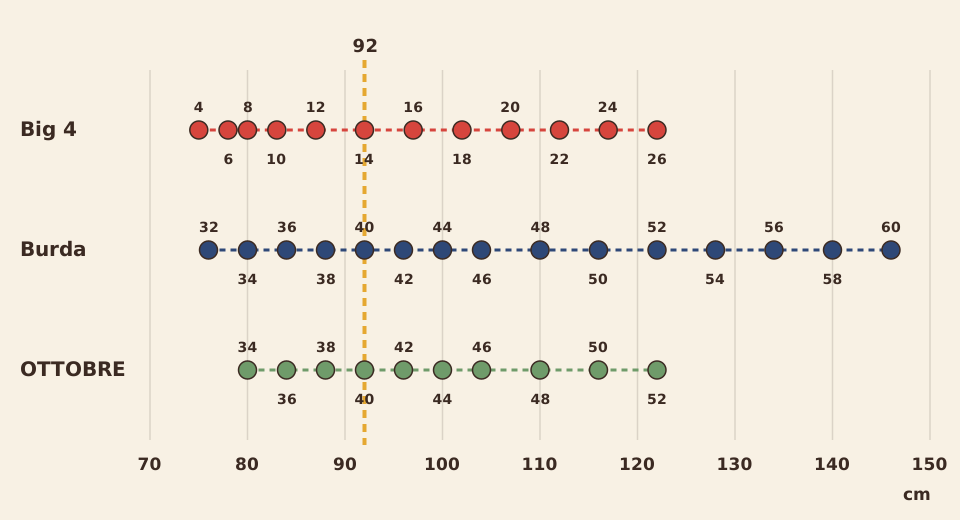
The chart shows why the size numbers line up the way they do. Each dot is one size at its bust measurement. Big 4 14, Burda 40 and OTTOBRE 40 all sit at 92 cm, which is also the EU label Simplicity prints next to its size 14. Burda's chart runs on to size 60 (bust 146 cm), the widest of the three charts plotted; the Big 4 Women's range below reaches a 60 in (152.5 cm) bust.
Burda size chart (women)
Burda is a metric brand, so read it in centimetres. The inches below are the values Burda's chart publishes on simplicity.com.
| Burda size | Bust cm (in) | Waist cm (in) | Hip cm (in) | US label printed |
|---|---|---|---|---|
| 32 | 76 (30) | 58 (23) | 82 (32 1/2) | 6 |
| 34 | 80 (31 1/2) | 62 (24 1/2) | 86 (34) | 8 |
| 36 | 84 (33) | 66 (26) | 90 (35 1/2) | 10 |
| 38 | 88 (34 3/4) | 70 (27 3/4) | 94 (37) | 12 |
| 40 | 92 (36 1/4) | 74 (29 1/4) | 98 (38 3/4) | 14 |
| 42 | 96 (37 3/4) | 78 (30 3/4) | 102 (40 1/4) | 16 |
| 44 | 100 (39 1/2) | 82 (32 1/2) | 106 (41 3/4) | 18 |
| 46 | 104 (41) | 86 (34) | 110 (43 1/2) | 20 |
| 48 | 110 (43 1/2) | 92 (36 1/4) | 116 (45 3/4) | 22 |
| 50 | 116 (45 3/4) | 98 (38 3/4) | 122 (48) | 24 |
| 52 | 122 (48) | 104 (41) | 128 (50 1/2) | 26 |
| 54 | 128 (50 1/2) | 110 (43 1/2) | 134 (52 3/4) | 28 |
| 56 | 134 (52 3/4) | 116 (45 3/4) | 140 (55 1/4) | 30 |
| 58 | 140 (55 1/4) | 122 (48) | 146 (57 1/2) | 32 |
| 60 | 146 (57 1/2) | 128 (50 1/2) | 152 (60) | 34 |
The published chart prints 30 1/2 in for size 34; 80 cm is 31 1/2 in, so we show the centimetre value converted. Bust steps 4 cm per size up to size 46, then 6 cm. Burda's regular sizes are generally drafted for a height of about 168 cm (5 ft 6 in), and Burda also offers petite and tall size groups; check the magazine or envelope you are using.
One practical note: Burda Style magazine patterns do not include seam allowance. You add it when you trace, usually 1 to 1.5 cm (3/8 to 5/8 in) on seams and 2 to 4 cm on hems. Envelope patterns state their own allowance, so read the envelope. The seam allowance guide has the full table by brand.
OTTOBRE size chart (women)
OTTOBRE design, from Finland, publishes centimetres. The inches here are calculated (cm divided by 2.54, to the nearest 1/8 in). OTTOBRE patterns, like Burda's magazine patterns, are traced and need seam allowance added.
| OTTOBRE size | Bust cm (in) | Waist cm (in) | Hip cm (in) | Back waist length cm (in) | Arm length cm (in) |
|---|---|---|---|---|---|
| 34 | 80 (31 1/2) | 64 (25 1/4) | 90 (35 3/8) | 40.4 (15 7/8) | 59.3 (23 3/8) |
| 36 | 84 (33 1/8) | 67 (26 3/8) | 93 (36 5/8) | 40.6 (16) | 59.7 (23 1/2) |
| 38 | 88 (34 5/8) | 70 (27 1/2) | 96 (37 3/4) | 40.9 (16 1/8) | 60 (23 5/8) |
| 40 | 92 (36 1/4) | 74 (29 1/8) | 99 (39) | 41.1 (16 1/8) | 60.2 (23 3/4) |
| 42 | 96 (37 3/4) | 78 (30 3/4) | 102 (40 1/8) | 41.3 (16 1/4) | 60.4 (23 3/4) |
| 44 | 100 (39 3/8) | 82 (32 1/4) | 106 (41 3/4) | 41.5 (16 3/8) | 60.6 (23 7/8) |
| 46 | 104 (41) | 86 (33 7/8) | 110 (43 1/4) | 41.7 (16 3/8) | 60.8 (23 7/8) |
| 48 | 110 (43 1/4) | 91 (35 7/8) | 115 (45 1/4) | 41.9 (16 1/2) | 61 (24) |
| 50 | 116 (45 5/8) | 97 (38 1/4) | 120 (47 1/4) | 42.1 (16 5/8) | 61.2 (24 1/8) |
| 52 | 122 (48) | 103 (40 1/2) | 125 (49 1/4) | 42.3 (16 5/8) | 61.4 (24 1/8) |
OTTOBRE gives more lengths than most brands. Its women's 38, for example, also lists a shoulder length of 13.2 cm, an upper arm of 27.5 cm and an outside leg of 106 cm, which makes it a lovely chart for checking sleeves and trouser lengths before you trace.
Big 4 Women's sizes: B cup Misses vs C cup Women's
The Big 4 Women's range (16W to 38W, letter sizes 1X to 6X on Simplicity) is drafted for the same height as Misses. Simplicity states that Women's patterns are drafted for a C cup, while Misses are drafted for a B cup.
| Size | High bust in (cm) | Bust in (cm) | Waist in (cm) | Hip in (cm) | Back waist length in (cm) |
|---|---|---|---|---|---|
| 16W | 37 (94) | 38 (97) | 31 (79) | 40 (102) | 16 3/4 (42.5) |
| 18W | 39 (99) | 40 (102) | 33 (84) | 42 (107) | 17 1/8 (43) |
| 20W | 41 (104) | 42 (107) | 35 (89) | 44 (112) | 17 1/4 (44) |
| 22W | 43 (109) | 44 (112) | 37 (94) | 46 (117) | 17 3/8 (44) |
| 24W | 45 (114) | 46 (117) | 39 (99) | 48 (122) | 17 1/2 (44.5) |
| 26W | 47 (119) | 48 (122) | 41 1/2 (105) | 50 (127) | 17 5/8 (45) |
| 28W | 49 (124) | 50 (127) | 44 (112) | 52 (132) | 17 3/4 (45) |
| 30W | 51 (130) | 52 (132) | 46 1/2 (118) | 54 (137) | 17 7/8 (45.5) |
| 32W | 53 (135) | 54 (137) | 49 (124) | 56 (142) | 18 (46) |
| 34W | 55 (140) | 56 (142.5) | 51 1/2 (130) | 58 (147) | 18 1/8 (46) |
| 36W | 57 (145) | 58 (147) | 53 (134) | 60 (152) | 18 1/4 (46.5) |
| 38W | 59 (150) | 60 (152.5) | 54 1/2 (138) | 62 (157.5) | 18 3/8 (47) |
Compare the overlap. Misses 16 and Women's 16W share a 38 in (97 cm) bust and a 40 in (102 cm) hip, but the 16W has a high bust of 37 in (94 cm) instead of 36 in (92 cm) and a waist 1 in (3 cm) larger. In other words, Women's patterns are cut for a broader upper body and a fuller waist at the same bust. If Misses patterns in your bust size feel narrow across the upper back and tight at the waist, compare your measurements with the Women's chart.
The Big 4 ease guide
Ease is the difference between the finished garment and your body. Wearing ease lets you move; design ease makes the silhouette. The 1998 Big 4 brochure says finished measurements, except close fitted styles, include at least 2 to 3 in (5 to 7.5 cm) of ease at bust and hip.
This is the Vogue, Butterick and McCall's Misses ease guide as widely reproduced. Use it to read the pattern description ("fitted", "loose fitting") and to compare with the finished measurements printed on the pattern.
| Fit | Bust: dresses, tops | Bust: jackets | Bust: coats | Hip: skirts, trousers |
|---|---|---|---|---|
| Close fitting | 0 to 2 7/8 in (0 to 7.3 cm) | not listed | not listed | 0 to 1 7/8 in (0 to 4.8 cm) |
| Fitted | 3 to 4 in (7.6 to 10.2 cm) | 3 3/4 to 4 1/4 in (9.5 to 10.8 cm) | 5 1/4 to 6 3/4 in (13.3 to 17.1 cm) | 2 to 3 in (5.1 to 7.6 cm) |
| Semi fitted | 4 1/8 to 5 in (10.5 to 12.7 cm) | 4 3/8 to 5 3/4 in (11.1 to 14.6 cm) | 6 7/8 to 8 in (17.5 to 20.3 cm) | 3 1/8 to 4 in (7.9 to 10.2 cm) |
| Loose fitting | 5 1/8 to 8 in (13 to 20.3 cm) | 5 7/8 to 10 in (14.9 to 25.4 cm) | 8 1/8 to 12 in (20.6 to 30.5 cm) | 4 1/8 to 6 in (10.5 to 15.2 cm) |
| Very loose fitting | over 8 in (20.3 cm) | over 10 in (25.4 cm) | over 12 in (30.5 cm) | over 6 in (15.2 cm) |
Knits are a different story: many knit patterns use zero or negative ease and size by the fabric's stretch. Follow the stretch guide printed on the pattern.
What size sewing pattern should I buy?
- Measure your body over underwear: high bust, bust, waist, hip and back waist length. Our body measurement guide walks through each one.
- Pick the measurement that rules the garment.
- Tops, dresses, jackets and coats: bust. If bust minus high bust is more than 2 1/2 in (6.3 cm), use your high bust instead and add a full bust adjustment.
- Skirts and trousers fitted through the hip: hip.
- Skirts that are not fitted at the hip: waist.
- Men's tops: chest; shirts also by neck and sleeve.
- Find that measurement on the brand's own chart. Never borrow one brand's chart for another.
- If you fall between sizes, take the smaller for a closer fit or a small frame and the larger for a looser fit or a large frame (Simplicity's rule).
- Check the finished garment measurements printed on the envelope or pattern tissue. They tell you how much ease the designer chose, which matters more than the size number.
- Grade between sizes where your measurements land in different sizes. Draw a smooth line from the bust size to the waist size to the hip size. Big 4 envelopes come in size groups, so buy the envelope that holds every size you need to blend.
Worked example (imperial)
Bust 36 in, high bust 34 in, waist 29 in, hip 39 in, sewing a fitted dress in Big 4 Misses. Bust minus high bust is 2 in, so choose by bust: 36 in is a size 14. Waist 29 in falls between 14 (28 in) and 16 (30 in). Hip 39 in falls between 14 (38 in) and 16 (40 in). Cut a 14 at the bust and blend out to the 16 lines at waist and hip for comfortable room, or trace between the 14 and 16 lines for a closer fit.
Worked example (metric)
Bust 92 cm, high bust 87 cm, waist 74 cm, hip 100 cm, sewing the same dress from Burda. Bust 92 cm is Burda 40, waist 74 cm is Burda 40, and hip 100 cm sits exactly between 40 (98 cm) and 42 (102 cm). Cut a 40 and add the 42 hip line if you like room through the seat. In OTTOBRE the same body is a 40 at every point, since the 40 hip is 99 cm.
Why is my pattern size bigger than my ready to wear size?
Because the two numbers measure different things. A pattern size is a fixed set of body measurements: the Big 4 Misses 12 has been bust 34 in (87 cm), waist 26 1/2 in (67 cm), hip 36 in (92 cm) since at least the 1998 brochure, and the live chart still prints exactly those values. Ready to wear brands set their own size labels, and they vary from shop to shop.
The fix is simple and freeing: ignore the label, use the tape. Lay your measurements against the chart, choose by the rules above, and check the finished garment measurements. Experienced makers rarely quote one pattern size. They say "14 at the bust, 16 at the hip", and every garment fits.
Where do the official standards fit in?
Body measurement methods are set by ISO 8559-1 (how to measure) and ISO 8559-2:2025 (which body dimensions label each garment type). Europe uses EN 13402, which labels clothes by body measurements in centimetres and names children's sizes by height. In the US, ASTM International publishes body measurement tables for each figure type, such as ASTM D5585 for Misses. Those tables are licensed standards whose terms do not allow their values to be reproduced, so this guide and SewNQuilt use the openly published pattern company charts, which are the charts you actually cut from. Japan's JIS L 4005:2023 (women) and L 4004:2023 (men) define the Japanese sizing framework; Japanese pattern books print their own size tables, so read the book's chart.
Children's pattern sizes in brief
- Europe and OTTOBRE: sizes are body height in centimetres, in 6 cm steps from 50 to 176. A size 110 is for a child about 110 cm tall. Choose by height, then check chest, waist and hip.
- US patterns (Big 4): infant sizes, toddler 1/2 to 4, children 2 to 8, girls and boys 7 to 16, each with its own measurement chart.
- US ready to wear: months (newborn, 0 to 3 months up to 18 to 24 months), then 2T to 5T, then 4 to 16. These labels are not pattern sizes.
- UK: age bands, usually printed with the height in centimetres.
- Japan: generally body height in 10 cm steps.
The most reliable choice across every brand is the child's height plus chest, measured fresh. Kids grow fast; remeasure every 3 months.
Mistakes and fixes
| Mistake | What happens | Fix |
|---|---|---|
| Buying your ready to wear size | The garment is too big or too small | Choose by body measurement on the brand's chart |
| Using one brand's chart for another | Off by a size at the hip | Read each brand's own chart, every time |
| Choosing tops by full bust with a C cup or larger | Gaping neckline, wide shoulders | Choose by high bust and add an FBA |
| Converting Burda inches by eye | Size 34 looks an inch smaller than it is | Read Burda in centimetres |
| Forgetting seam allowance on Burda magazine or OTTOBRE patterns | The garment comes out a size smaller | Add seam allowance when tracing |
| Ignoring the finished measurements | A "fitted" style feels tight | Compare finished bust and hip with your body plus your favourite ease |
| One size everywhere | Tight hips or a baggy waist | Grade between sizes at waist and hip |
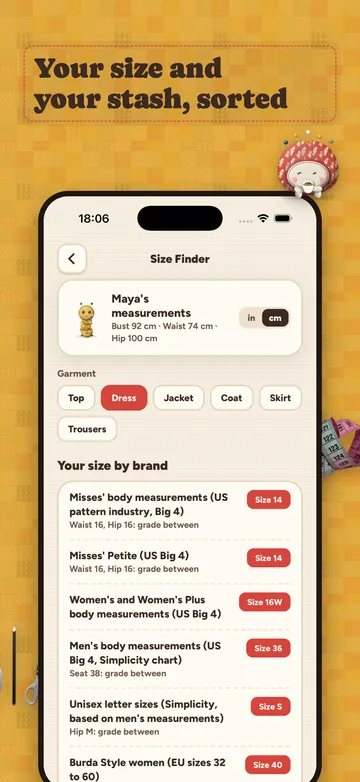
Size Finder: your size in every brand
This page takes a pencil and three charts. SewNQuilt takes one tap. Save your measurements once in a measurement profile (for you, your family, even the dog) and Size Finder reads your size in each pattern company's chart: Big 4 Misses, Petite, Women's, Men's, Unisex, Burda and more. Inches or centimetres, your choice.
Then sew it. SewNQuilt's own patterns print in your size, tiled on US Letter or A4, as an A0 copyshop file, or on a calibrated projector. Ask Pip "which size for this dress?" and Pip already knows your numbers.
SewNQuilt Pro: weekly, monthly or yearly plans ($49.99 a year in the US). Meet SewNQuilt and let Inchy keep the charts.
FAQ
Are Simplicity and McCall's sizes the same?
Yes for the Misses range. Simplicity, McCall's, Butterick, Vogue and New Look use the same Misses body measurements: a 12 is bust 34 in (87 cm), waist 26 1/2 in (67 cm), hip 36 in (92 cm). Always check the finished garment measurements, because each design adds its own ease.
What size is a Burda 38 in US pattern sizes?
Burda prints US 12 next to its 38. By measurement, Burda 38 is bust 88 cm, waist 70 cm, hip 94 cm, while Big 4 12 is 87, 67 and 92 cm. Close at the bust, a little fuller at waist and hip, so choose by your own measurements in each chart.
Why is my sewing pattern size so much bigger than my store size?
Pattern sizes are fixed body measurements that have not changed since at least 1998. Store labels are set by each brand. The number on the envelope is just a name for a set of measurements, so go by the tape.
What if I am between two sizes?
Take the smaller size for a closer fit or a small frame and the larger for a looser fit or a large frame. If bust, waist and hip fall in different sizes, grade between them on a multi size pattern.
Should I choose my size by bust or high bust?
Subtract high bust from bust. Up to 2 1/2 in (6.3 cm), choose by bust. More than that, choose by high bust so the shoulders and neckline fit, then add a full bust adjustment.
Do pattern sizes include ease?
The size chart is body measurements only. The pattern adds ease on top: at least 2 to 3 in (5 to 7.5 cm) at bust and hip for most woven styles, according to the 1998 Big 4 brochure. The finished garment measurements show exactly how much.
How do children's pattern sizes work?
European and OTTOBRE children's sizes are the child's height in centimetres (size 104 for about 104 cm tall). US patterns use age style sizes with a measurement chart. Measure height and chest and choose from the chart, never by age alone.
Related guides
Sources
All checked 31 October 2026.
- Simplicity size charts (Simplicity, McCall's, Butterick, Vogue, New Look, Burda Style). Simplicity. https://simplicity.com/size-charts/
- Pattern Sizing and Body Measurements, McCall Pattern Company and Simplicity Creative Group (PDF). https://www.hobbycraft.co.uk/on/demandware.static/-/Library-Sites-hobbycraft-uk-content/default/images/brand/simplicity/hobbycraft_simplicity_measurement_chart.pdf
- Do You Really Know Your Pattern Size? Simplicity, McCall's, Vogue and Butterick fit brochure (1998), hosted by Threads. https://images.threadsmagazine.com/app/uploads/2008/10/11135606/fitbroch.pdf
- OTTOBRE design size charts and measuring. OTTOBRE design. https://www.ottobredesign.com/pages/size-charts
- Vogue, McCall's and Butterick fitting guide, Misses' ease allowances (reproduction). Weaverdee. https://weaverdee.com/pages/fit_vogue-butterick-mccall
- ISO 8559-1:2017, Anthropometric definitions for body measurement. ISO. https://www.iso.org/standard/61686.html
- ISO 8559-2:2025, Primary and secondary dimension indicators. ISO. https://www.iso.org/standard/85590.html
- EN 13402-3, Size designation of clothes, measurements and intervals. CEN (iTeh catalogue). https://iteh.eu/catalog/standards/cen/75aa24eb-beef-417a-8010-5bf9fce5c968/en-13402-3-2004
- ASTM D5585-21, Standard Tables of Body Measurements for Adult Female Misses Figure Type, Size Range 00 to 20. ASTM International. https://www.astm.org/Standards/D5585.htm
- ASTM Subcommittee D13.55 on Body Measurements for Apparel Sizing, jurisdiction list. ASTM International. https://www.astm.org/membership-participation/technical-committees/committee-d13/subcommittee-d13/jurisdiction-d1355
- JIS L 4005:2023, Sizing systems for women's clothes (preview). Japanese Standards Association. https://webdesk.jsa.or.jp/preview/pre_jis_l_04005_000_000_2023_e_ed10_ch.pdf
Image credits
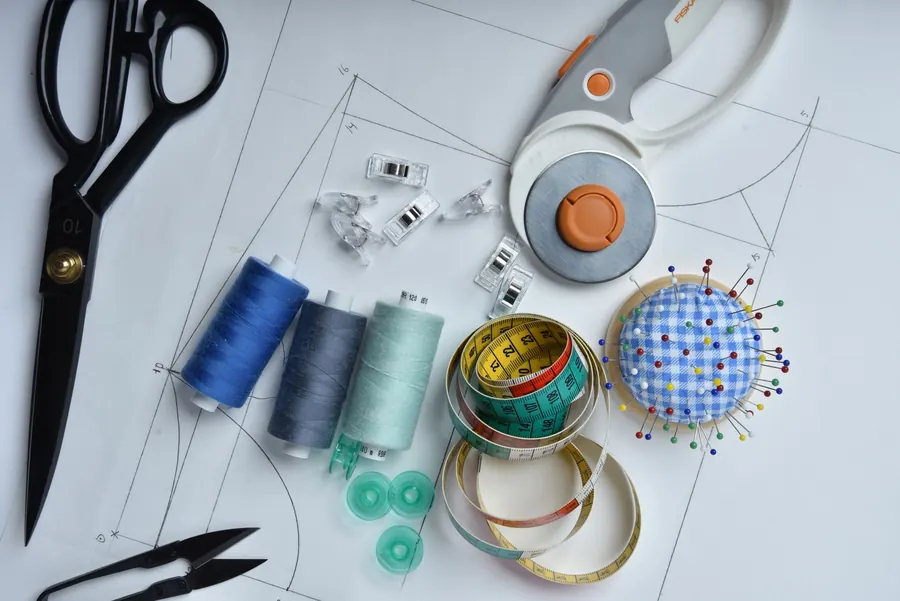
- Sewing tools on pattern paper: Jacob Moseholt on Pexels, https://www.pexels.com/photo/sewing-tools-and-accessories-on-pattern-paper-31070320/ (ID 31070320), Pexels License.
- Chart: SewNQuilt, from the Simplicity (Big 4 and Burda) and OTTOBRE published charts.
- Screenshot: the SewNQuilt app.