Sewing machine needle sizes at a glance
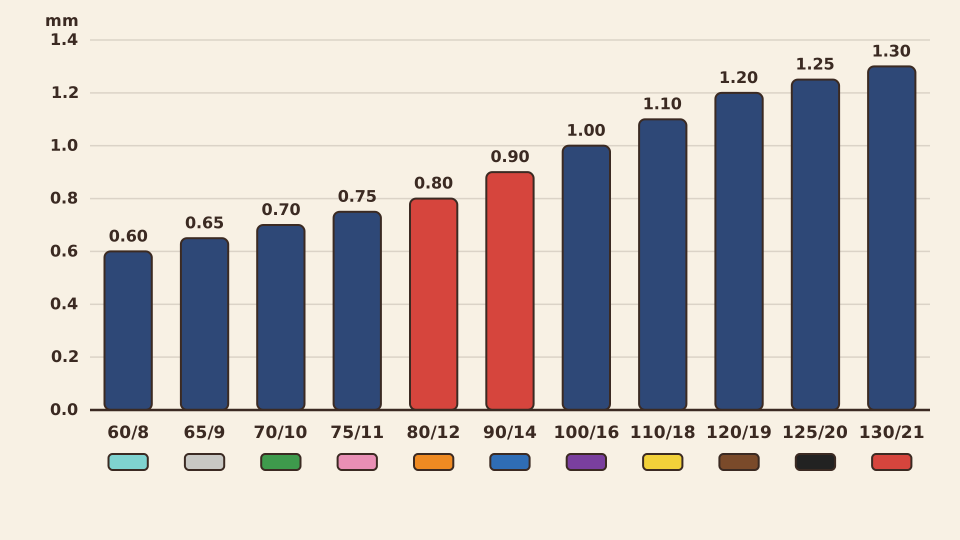
Every needle for a home lockstitch machine carries two numbers. The first is the European metric size (NM, from the German Nummer metrisch). The second is the older US scale, which is just a label with no unit behind it. The colour column is the SCHMETZ size band, the lower stripe on the needle shank.
| NM/US | Blade diameter | SCHMETZ size band | Typical fabrics |
|---|---|---|---|
| 60/8 | 0.60 mm | light turquoise | silk habotai, chiffon, organza, tulle, fine lingerie |
| 65/9 | 0.65 mm | light grey | voile, fine lawn, chiffon |
| 70/10 | 0.70 mm | green | lawn, batiste, poplin, fine jersey, 50 to 60 wt thread |
| 75/11 | 0.75 mm | pink | light knits (Stretch), swimwear, machine embroidery, piecing |
| 80/12 | 0.80 mm | orange | quilting cotton, shirting, poplin, cotton jersey |
| 90/14 | 0.90 mm | blue | linen, twill, flannel, light denim, sweatshirt fleece |
| 100/16 | 1.00 mm | purple | 10 oz denim, canvas, coating, home dec |
| 110/18 | 1.10 mm | yellow | heavy denim, upholstery, heavy canvas, topstitch thread |
| 120/19 | 1.20 mm | brown | very heavy canvas, webbing, many layers |
| 125/20 | 1.25 mm | black | very heavy, mostly industrial |
| 130/21 | 1.30 mm | red | very heavy, mostly industrial and long arm |
How do I read a sewing machine needle size?
Read the NM number and you know the needle's thickness. NM 80 means the blade is 0.80 mm across just above the scarf, the scooped section on the back of the needle. NM 90 is 0.90 mm. That is the whole system, and it is why the metric number comes first, written NM/US, on every pack.
The US numbers (8, 9, 10, 11, 12, 14, 16, 18) follow no formula. They are a legacy scale from Singer. So don't try to calculate with them: 90/14 is not "two more" than 80/12 in any physical sense. It is 0.10 mm thicker.
What does 130/705 H mean on the pack?
That code is the needle system, and it matters more than size. 130/705 H (also sold as HAx1 or 15x1) fits virtually every domestic lockstitch machine. 130 is the length code, 705 means a flat shank, and H stands for the scarf (Hohlkehle). Letters after the H name the type: H-J jeans, H-M microtex, H-S stretch, H SUK jersey, H-Q quilting, H-E embroidery, and so on. SCHMETZ gives the shank diameter of all household 130/705 H needles as 2.04 mm, so every size fits the same clamp.
Two exceptions to know:
- Overlockers and coverstitch machines often take ELx705, BLx1 or DCx1. Your manual decides. SCHMETZ is clear that BLx1 and DCx1 are not interchangeable.
- Long arm quilting machines use round shank systems such as 135x5 or 135x17, and industrial straight stitch machines use DBx1. A round shank needle never goes in a flat shank clamp.
The SCHMETZ colour code
SCHMETZ needles carry up to two colour bands. The top band is the type and the lower band is the size. A Microtex 80/12 shows purple over orange. Universal needles show only the size band. That habit saves you squinting at the tiny engraving on the shank, which is the only other place the size appears once the needle leaves its case.
Watch out: some type colours match size colours. Quilting is green on top, and 70/10 is green on the bottom. Topstitch is light turquoise on top, the same as the 60/8 size band. Position tells you which is which.
Needle types chart: which needle point do I need?
Size handles thickness. Type handles the point, the eye and the scarf, and the wrong type causes more skipped stitches than the wrong size.
| Type (system code) | Type band | Point and eye | Sizes | Use it for |
|---|---|---|---|---|
| Universal (130/705 H) | none, size band only | slightly rounded point | 60/8 to 120/19 | most stable wovens and many stable knits |
| Jersey, ball point (H SUK) | orange | medium ball point | 70/10, 80/12, 90/14, 100/16 | cotton jersey, interlock, rib, sweatshirt fleece |
| Stretch (H-S) | yellow | medium ball, deep scarf | 75/11, 90/14 | elastane knits, swim, activewear, power mesh |
| Jeans (H-J) | blue | reinforced blade; SCHMETZ describes a medium ball point | 70/10 to 110/18 | denim, canvas, duck, heavy twill, many layers |
| Microtex, sharp (H-M) | purple | very slim acute point | 60/8, 70/10, 80/12, 90/14 | silk, microfibre, batiste, coated fabrics, faux leather |
| Quilting (H-Q) | green | slightly rounded point, special taper | 75/11, 90/14 | piecing and machine quilting through layers |
| Embroidery (H-E) | red | enlarged eye, wider groove | 75/11, 90/14 | machine embroidery, rayon and poly 40 wt |
| Metallic (H-MET) | pink | elongated eye, larger groove | 80/12, 90/14 | metallic and specialty threads |
| Topstitch (130 N) | light turquoise | eye about twice as long | 80/12, 90/14, 100/16 | topstitch thread, two threads, heavy quilting thread |
| Leather (H LL) | brown | cutting point | 70/10 to 110/18 | real leather and suede |
| Universal twin (H ZWI) | none | two needles on one shank | 1.6/70 to 8.0/100 | pintucks, twin topstitching, knit hems |
| Stretch twin (H-S ZWI) | yellow | two stretch needles | 2.5/75, 4.0/75 | coverstitch look hems on knits |
| Super NonStick (H-SU) | size band only | coated, large eye | 70/10 to 100/16 | fusibles and sticky stabilizers |
| Overlock (ELx705) | black | two thread grooves | 80/12, 90/14 | home sergers and coverstitch machines that specify it |
On a twin needle the first number is the spacing in millimetres and the second is the NM size. A 4.0/80 sews two rows 4 mm (about 5/32 in) apart with two 80 needles. SCHMETZ reminds you to use the zigzag needle plate and keep the stitch width inside its opening, or the needles hit the plate and break. Twins wider than 4 mm need a wide stitch plate.
Ballpoint vs stretch needle: which one for knits?
Both have a medium ball point that slips between knit loops instead of piercing them. The difference is in the rest of the needle.
- Jersey (ball point) is the everyday knit needle. Use it for cotton jersey, interlock, rib, French terry and sweatshirt fleece. Sizes 70/10, 80/12, 90/14 and 100/16. There is no Jersey 75/11.
- Stretch has a deeper scarf and, as SCHMETZ explains, a flatter shank that forms the stitch closer to the hook. That is exactly what stops skipped stitches on elastane. Choose it for swim, leggings, activewear, ponte and any knit with a noticeable Lycra or spandex content. It comes in 75/11 and 90/14 only.
Our rule of thumb in the studio: if the knit snaps back when you stretch it, start with Stretch 75/11. If it relaxes slowly, start with Jersey 80/12.
Universal, Microtex or Quilting for patchwork?
All three piece beautifully. SCHMETZ itself says the difference between Universal and Quilting is the special taper on the Quilting point, which eases penetration through layers and reduces skipped stitches. Microtex makes the straightest stitch line on tightly woven batiks and fine cotton. For a first quilt, put a Universal 80/12 in for piecing and a Quilting 90/14 in for quilting the sandwich. Both are cheap and easy to find.
What needle for which fabric?
These pairings come from the SCHMETZ ABC Pocket Guide and our fabric library. Weights are typical ranges, given in grams per square metre (g/m²) and ounces per square yard (oz/yd²). When a fabric sits between two sizes, choose the smaller needle for a finer stitch and the larger one for thick seams or heavier thread.
Light and sheer wovens
| Fabric | Weight | Needle | Stitch length |
|---|---|---|---|
| Chiffon, georgette, silk organza | 25 to 90 g/m² (0.7 to 2.7 oz/yd²) | Microtex 60/8 or 70/10 | 1.8 to 2.0 mm |
| Tulle | 10 to 30 g/m² (0.3 to 0.9 oz/yd²) | Microtex 60/8 or 70/10 | 2.0 mm |
| Voile | 50 to 90 g/m² (1.5 to 2.7 oz/yd²) | Microtex 60/8 or 70/10 | 2.0 mm |
| Lawn, batiste | 50 to 90 g/m² (1.5 to 2.7 oz/yd²) | Microtex 60/8 or 70/10 | 2.0 mm |
| Silk crepe de chine, charmeuse | 50 to 110 g/m² (1.5 to 3.2 oz/yd²) | Microtex 60/8 or 70/10 | 2.0 mm |
| Poplin, oxford shirting | 100 to 160 g/m² (2.9 to 4.7 oz/yd²) | Microtex 70/10 or 80/12 | 2.2 mm |
| Rayon challis, viscose crepe | 100 to 180 g/m² (2.9 to 5.3 oz/yd²) | Microtex 70/10 or 80/12 | 2.2 mm |
| Light linen | 100 to 150 g/m² (2.9 to 4.4 oz/yd²) | Microtex 70/10 or 80/12 | 2.5 mm |
What size needle for cotton?
Quilting cotton and other medium cottons sew best on an 80/12.
| Fabric | Weight | Needle | Stitch length |
|---|---|---|---|
| Quilting cotton | 130 to 160 g/m² (3.8 to 4.7 oz/yd²) | Universal 80/12 (Quilting 75/11 also works) | 2.0 to 2.2 mm piecing, 2.5 mm garments |
| Muslin (calico in the UK), gingham, broadcloth | 100 to 160 g/m² (2.9 to 4.7 oz/yd²) | Universal 70/10 or 80/12 | 2.5 mm |
| Double gauze, chambray | 110 to 170 g/m² (3.2 to 5.0 oz/yd²) | Universal 80/12 | 2.5 mm |
| Cotton flannel | 140 to 220 g/m² (4.1 to 6.5 oz/yd²) | Universal 80/12 or 90/14 | 2.5 mm |
| Midweight linen | 150 to 220 g/m² (4.4 to 6.5 oz/yd²) | Universal 80/12 or 90/14 | 2.5 mm |
| Cotton twill | 170 to 270 g/m² (5.0 to 8.0 oz/yd²) | Universal 90/14 | 2.8 mm |
| Heavy linen | 220 to 350 g/m² (6.5 to 10.3 oz/yd²) | Universal 90/14 or 100/16 | 2.8 mm |
| Home dec cotton | 200 to 350 g/m² (5.9 to 10.3 oz/yd²) | Universal 90/14 or 100/16 | 2.8 mm |
| Quilt sandwich (top, batting, backing) | layered | Quilting 75/11 or 90/14 | 2.5 to 3.5 mm walking foot |
What needle for denim and canvas?
Denim is sold by weight, and the needle follows the weight. Pick a Jeans needle: its reinforced blade resists bending as it climbs seam humps.
| Fabric | Weight | Needle | Stitch length |
|---|---|---|---|
| Light denim | 140 to 220 g/m² (4.1 to 6.5 oz/yd²) | Jeans 80/12 or 90/14 | 2.8 mm |
| Midweight denim | 270 to 400 g/m² (8.0 to 11.8 oz/yd²) | Jeans 90/14 or 100/16 | 3.0 mm |
| Stretch denim | 270 to 370 g/m² (8.0 to 10.9 oz/yd²) | Jeans 90/14 or 100/16 | 3.0 mm |
| Heavy denim | 400 to 550 g/m² (11.8 to 16.2 oz/yd²) | Jeans 100/16 or 110/18 | 3.5 mm |
| Chino, drill | 200 to 300 g/m² (5.9 to 8.8 oz/yd²) | Jeans 90/14 or 100/16 | 3.0 mm |
| Canvas, duck | 340 to 610 g/m² (10.0 to 18.0 oz/yd²) | Jeans 100/16 or 110/18 | 3.0 mm |
| Cordura nylon | 200 to 400 g/m² (5.9 to 11.8 oz/yd²) | Jeans 90/14 or 100/16 | 3.0 mm |
| Upholstery weight | 300 to 700 g/m² (8.8 to 20.6 oz/yd²) | Jeans 100/16 or 110/18 | 3.5 mm |
A tip from many pairs of jeans: hammer the seam intersection flat before you cross it, and slip a folded card behind the foot so it stays level as it climbs.
Knits, swim and fleece
| Fabric | Weight | Needle |
|---|---|---|
| Cotton jersey | 140 to 200 g/m² (4.1 to 5.9 oz/yd²) | Jersey 70/10 or 80/12 |
| Interlock, rib knit | 180 to 300 g/m² (5.3 to 8.8 oz/yd²) | Jersey 70/10 or 80/12 |
| French terry | 220 to 330 g/m² (6.5 to 9.7 oz/yd²) | Jersey 80/12 or 90/14 |
| Sweatshirt fleece | 260 to 380 g/m² (7.7 to 11.2 oz/yd²) | Jersey 90/14 |
| Cotton spandex jersey | 180 to 260 g/m² (5.3 to 7.7 oz/yd²) | Stretch 75/11 or 90/14 |
| Rayon spandex, modal or bamboo jersey | 150 to 250 g/m² (4.4 to 7.4 oz/yd²) | Stretch 75/11 |
| Ponte | 270 to 380 g/m² (8.0 to 11.2 oz/yd²) | Stretch 75/11 or 90/14 |
| Swim tricot, activewear | 180 to 320 g/m² (5.3 to 9.4 oz/yd²) | Stretch 75/11 or 90/14 |
| Polar fleece | 180 to 400 g/m² (5.3 to 11.8 oz/yd²) | Stretch 90/14 (SCHMETZ also lists Universal 70/10 to 90/14) |
| Minky | 250 to 400 g/m² (7.4 to 11.8 oz/yd²) | Stretch 90/14 |
Leather, vinyl, sequins and other specialty fabrics
| Fabric | Weight or thickness | Needle | Stitch length |
|---|---|---|---|
| Garment leather | 2 to 3 oz leather, 0.8 to 1.2 mm (1 oz is about 1/64 in) | Leather 80/12, 90/14 or 100/16 | 3.5 mm |
| Faux leather (PU), vinyl | 250 to 600 g/m² (7.4 to 17.7 oz/yd²) | Microtex 80/12 or 90/14 | 3.5 mm |
| Clear vinyl | 10 to 16 gauge suits pouches | Microtex 80/12 or 90/14 | 3.0 to 3.5 mm |
| Cork fabric | 250 to 450 g/m² (7.4 to 13.3 oz/yd²) | Microtex 80/12 or 90/14 | 3.0 mm |
| Sequin fabric | 150 to 400 g/m² (4.4 to 11.8 oz/yd²) | Microtex 80/12 or 90/14; Stretch 90/14 on sequin knits | 2.5 mm |
| Velvet | 200 to 400 g/m² (5.9 to 11.8 oz/yd²) | Universal 70/10 or 80/12 (or Stretch 75/11) | 2.5 mm |
| Ripstop nylon | 30 to 120 g/m² (0.9 to 3.5 oz/yd²) | Microtex 70/10 or 80/12 | 2.5 mm |
| PUL | 100 to 200 g/m² (2.9 to 5.9 oz/yd²) | Microtex 70/10 or 80/12 | 3.0 mm |
| Wool suiting | 200 to 320 g/m² (5.9 to 9.4 oz/yd²) | Universal 80/12 or 90/14 | 2.5 mm |
| Wool coating, melton | 450 to 750 g/m² (13.3 to 22.1 oz/yd²) | Universal 100/16 or 110/18 | 3.0 mm |
The leather needle has a cutting point. Keep it for real leather. On faux leather and vinyl a Microtex leaves a clean round hole that tears far less, and SCHMETZ lists vinyl under Microtex. Every hole in leather and vinyl is permanent, so test on a scrap and lengthen the stitch.
Needle 80/12 vs 90/14: which should I use?
The 90/14 is 0.10 mm thicker, 12.5 percent wider than the 80/12. That small step changes three things: the size of the hole, the stiffness of the needle and the size of the eye.
Choose 80/12 for quilting cotton, shirting, poplin, light flannel and cotton jersey (in a Jersey point), with all purpose or 50 wt thread. Choose 90/14 for midweight linen, twill, light denim, sweatshirt fleece, bag making with interfacing, and machine quilting with 40 wt thread. If an 80/12 shreds thread, bends on seam allowances or skips at thick crossings, go up to 90/14. If a 90/14 leaves visible holes in fine cotton, go down.
Worked examples
1. Denim jeans, US label. The bolt says 10 oz denim. That is 10 oz/yd², which lies in the midweight band (8.0 to 11.8 oz/yd²). Needle: Jeans 90/14 for construction, 100/16 if your seams stack six layers. Stitch length 3.0 mm, about 8 1/2 stitches per inch (25.4 ÷ 3.0 = 8.5).
2. The same denim, EU label. A European shop lists it as 340 g/m². Read it against the metric band directly: 270 to 400 g/m² is midweight. Same answer: Jeans 90/14 or 100/16, 3.0 mm stitch. (For the curious: 340 g/m² × 0.02949 = 10.0 oz/yd².)
3. A fabric sold by weight per linear yard. Some US shops quote ounces per linear yard. Convert to square yards with oz/yd² = oz per linear yard × 36 ÷ width in inches. A cotton listed at 5 oz per linear yard, 44 in wide: 5 × 36 ÷ 44 = 4.1 oz/yd², about 139 g/m². That is quilting cotton territory: Universal 80/12.
4. A T shirt from a metric pattern. The fabric is 180 g/m² cotton jersey with no elastane: Jersey 70/10 or 80/12. If the label says 95 percent cotton and 5 percent elastane, switch to Stretch 75/11. Imperial makers reading 5.3 oz/yd² on the same jersey choose exactly the same needle.
Needle and thread chart: matching thread by Tex
The thread has to pass freely through the eye and lie in the long groove on the front of the needle. Too thick a thread for the needle frays, shreds and loops. A common workshop rule is that the thread should fill about 40 percent of the eye.
Weight (wt) labels differ between brands, so compare threads by Tex, the international measure of grams per 1000 m. A higher Tex is a thicker thread. Many spools print it; if yours does not, the maker's website usually lists it.
| Thread | Tex | Suggested needle |
|---|---|---|
| Fine 60 to 80 wt polyester or cotton | Tex 18 to 21 | 60/8 to 75/11 |
| Fine all purpose, for example Gütermann Mara 120 | Tex 25 | 70/10 to 80/12 |
| All purpose, for example Mara 100 | Tex 27 to 30 | 70/10 to 90/14 |
| Heavy duty | Tex 40 | 90/14 to 100/16 |
| Jeans and upholstery | Tex 60 to 70 | 100/16 to 110/18, or topstitch |
| Topstitch, for example Mara 30 | Tex 80 to 105 (Mara 30 is Tex 100) | Topstitch 100/16 |
| Bonded nylon or polyester | Tex 45 / Tex 70 / Tex 90 / Tex 135 | 90/14 to 100/16 / 100/16 to 110/18 / 110/18 / 120/19 |
These pairings come from thread makers' published data and retail listings, so check the spool too. For bonded threads, Amann lists minimum industrial sizes of Nm 80, 90, 100 and 120 for Tex 45, 70, 90 and 135; home machines usually sew best one size up.
For topstitching with heavy thread, put the heavy thread on top only and all purpose thread in the bobbin, with a Topstitch needle. Its long eye is the reason it works.
Converting Tex, denier and Nm
| Tex | dtex | Denier | Nm (m per g) | Ne (cotton count) |
|---|---|---|---|---|
| 25 | 250 | 225 | 40.0 | 23.6 |
| 30 | 300 | 270 | 33.3 | 19.7 |
| 40 | 400 | 360 | 25.0 | 14.8 |
| 100 | 1000 | 900 | 10.0 | 5.9 |
Formulas: dtex = Tex × 10, denier = Tex × 9, Nm = 1000 ÷ Tex, Ne = 590.54 ÷ Tex (Coats and Amann thread numbering).
Quilting thread weights and needles
Quilters mostly shop by weight, where a higher number means a finer thread. Compare weights within one brand and ply.
| Task | Thread | Machine needle |
|---|---|---|
| Machine piecing | 50 wt cotton, or 60 wt for tiny pieces | 70/10 to 80/12 Quilting, Microtex or Universal |
| Foundation paper piecing | 50 or 60 wt | 90/14 with a 1.5 mm stitch to perforate the paper |
| Machine appliqué | 50 to 80 wt cotton, 100 wt silk or monofilament | 60/8 to 70/10 Microtex |
| Machine quilting, standard | 40 wt cotton or polyester | 90/14 Quilting or Topstitch |
| Machine quilting, fine | 50 wt cotton or 60 wt polyester | 80/12 Topstitch |
| Bold quilting | 28 wt or 12 wt cotton | 90/14 Topstitch (28 wt), 100/16 Topstitch (12 wt) |
Thread companies such as Superior Threads recommend Topstitch needles for many quilting threads because of the long eye and deep groove. Check the size against the chart for your thread.
Hand needle sizes: higher number, finer needle
Hand needles run the other way from machine needles. A higher size number means a finer, shorter needle. A size 10 sharp is slimmer than a size 5.
| Hand needle | Sizes | Use |
|---|---|---|
| Sharps | 1 to 12 (9 and 10 are most common) | general hand sewing, hems, buttons |
| Betweens | 3 to 12 | hand quilting (9 to 12), fine detail, tailoring |
| Embroidery, crewel | 1 to 10 | stranded floss, crewel wool |
| Milliners, straw | 1 to 11 | basting, French and bullion knots, EPP and needle turn appliqué (10 or 11) |
| Beading | 10 to 15 | seed beads, sequins |
| Chenille | 13 to 26 | wool and ribbon embroidery, perle cotton big stitch |
| Tapestry | 13 to 28 | blunt tip for cross stitch, weaving in ends |
| Glovers, leather | 3 to 8 | hand sewing leather and suede |
| Sashiko | long, about 4.5 to 5.5 cm (1 3/4 to 2 1/4 in), varies by brand | sashiko and visible mending |
When should I change my sewing machine needle?
Fit a fresh needle at the start of every project. Then change it the moment you notice one of the warning signs SCHMETZ lists:
- fabric snagging, puckering or being pushed into the needle plate,
- uneven or skipped stitches,
- thread shredding or breaking,
- a clicking, popping or clunking sound as the needle goes in.
SCHMETZ also gives a simple timer: a new needle at the start of each project or after about 8 hours of sewing, whichever comes first, and a new one at once if it bends, hits a pin or skips stitches. Synthetics, batting, paper piecing and sticky stabilizers dull a needle faster than cotton does. And if you hit a pin, change the needle straight away: SCHMETZ explains the point is damaged even when the needle survives.
How to change a sewing machine needle
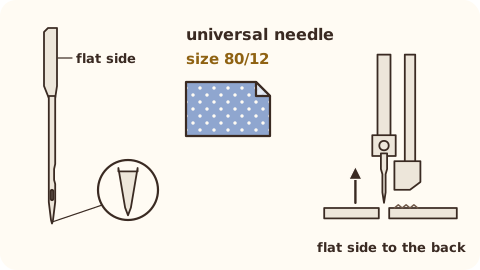
- Switch the machine off. Turn the handwheel toward you until the needle is at its highest point.
- Lay a scrap of fabric under the presser foot and lower the foot, so the old needle cannot drop into the needle plate.
- Hold the needle and loosen the needle clamp screw. Slide the old needle out.
- Insert the new needle with the flat side of the shank to the back on most front loading domestic machines. Some machines differ, so check your manual.
- Push it up until it stops. A needle that sits low is a classic cause of skipped stitches.
- Tighten the clamp screw firmly, then rethread the needle front to back.
- Turn the handwheel one full turn by hand and sew a few stitches on a scrap.
Keep a pincushion just for part used needles and mark each section with its type and size. You will thank yourself on the next project.
Mistakes and fixes
Using a Universal needle on swimwear. Skipped stitches follow, every time. Fix: Stretch 75/11.
Choosing a leather needle for faux leather. The cutting point slices the backing and seams tear along the holes. Fix: Microtex 80/12 or 90/14 and a long stitch.
Sewing heavy topstitch thread through an 80/12. The thread frays in the eye and breaks. Fix: Topstitch 100/16 with all purpose thread in the bobbin.
Reading the US number as a measurement. 14 is not "bigger by 2" than 12. Fix: think in NM, where 90 means 0.90 mm.
Mixing up quilting green and size green. On SCHMETZ needles the top band is the type. Fix: read the lower band for size.
Keeping the same needle for a whole quilt. Piecing a queen quilt and then quilting it is a lot of hours. Fix: one fresh needle for piecing, another for quilting, and swap at the first warning sign.
Using a twin needle on a straight stitch plate. The second needle strikes the plate. Fix: zigzag plate and twin needle setting.
The needle chart that lives in your pocket
Matching needle, thread and fabric gets easy when the chart comes with you. In SewNQuilt, the fabric library holds 113 fabrics, each with its weight in g/m² and oz/yd², needle type and size, thread, pressing and care. Inchy runs the needle size and thread size calculators in the Tools tab, so a spool label in Tex or weight turns into the right needle in a tap.
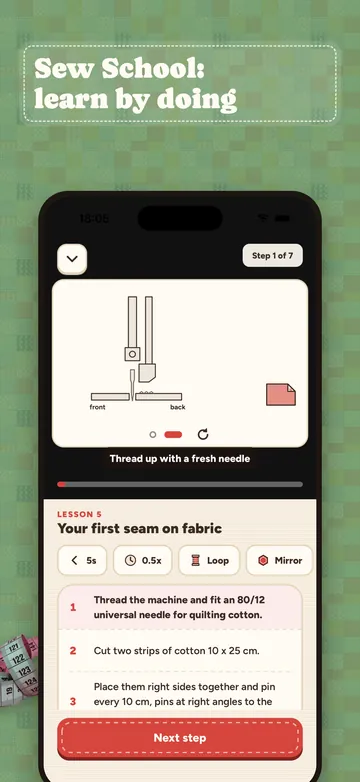
Mabel teaches the rest in Machine School. "Which needle for which fabric" walks you through reading sizes and fitting a needle the right way round, and Sew School lessons tell you which needle to fit before the first seam, like the 80/12 below. Not sure about that mystery fabric in your stash? Snap it and Ask Pip.
SewNQuilt Pro comes in weekly, monthly or yearly plans ($49.99 a year in the US). Meet SewNQuilt.
FAQ
What size sewing machine needle should I use for cotton?
Use an 80/12 for quilting cotton and medium cottons, in a Universal, Quilting or Microtex type. Go down to 70/10 for poplin and lawn, and to 60/8 for voile. Use 90/14 for cotton twill, flannel and heavier home dec cotton.
What is the difference between 80/12 and 90/14 needles?
The 80/12 has a 0.80 mm blade and the 90/14 has a 0.90 mm blade. The 90/14 is stiffer, has a larger eye and makes a slightly bigger hole, so it suits linen, twill, light denim and 40 wt quilting thread. The 80/12 suits quilting cotton and shirting.
Is a ballpoint needle the same as a stretch needle?
No. Both have a medium ball point, but the Stretch needle has a deeper scarf and forms the stitch closer to the hook, which prevents skipped stitches on elastane knits. Use Jersey (ball point) for cotton jersey and sweatshirt fleece, and Stretch 75/11 or 90/14 for swim, activewear and spandex blends.
What needle should I use for denim?
A Jeans needle sized to the denim weight: 90/14 or 100/16 for midweight denim of 8 to 11.8 oz/yd² (270 to 400 g/m²), and 100/16 or 110/18 for heavy denim. For topstitching with heavy thread, use a Topstitch 100/16.
What do the colours on SCHMETZ needles mean?
The top band shows the needle type and the lower band shows the size. For example, Jeans is blue, Stretch yellow, Microtex purple and Quilting green on top, while 80/12 is orange and 90/14 blue on the bottom. Universal needles carry only the size band.
How often should I change my sewing machine needle?
Fit a new needle at the start of each project or after about 8 hours of sewing, whichever comes first, as SCHMETZ advises. Change it at once if it bends, hits a pin or skips stitches, or if thread shreds, fabric puckers or snags, or you hear clicking.
Which way does the flat side of the needle go?
On most front loading domestic machines the flat side of the shank faces the back. Push the needle all the way up before tightening the screw. Vintage and side loading machines can differ, so your manual has the final word.
Do hand needle sizes work like machine needle sizes?
No, they run the opposite way. For hand needles, a higher number means a finer and shorter needle, so a size 12 between is finer than a size 9.
Related guides
- Sewing machine troubleshooting: bird nests, skipped stitches and tensionRead the guide
- Sewing for beginners: your first weekRead the guide
- Seam allowance for sewing and quiltingRead the guide
- How to make your first quilt, start to finishRead the guide
- How much fabric do I need?Read the guide
- Seam allowance converter (free tool)Open the tool
Sources
- SCHMETZ, Color Code Chart (revised 2025). https://cdn.shopify.com/s/files/1/0579/8857/9507/files/SCHMETZ-Color-Code-Chart-Base-Revised-2025-012125.pdf (checked 31 Oct 2026)
- SCHMETZ, home sewing needle catalog (systems, types and sizes). https://www.schmetzneedles.com/collections/all-sewing-machine-needles (checked 31 Oct 2026)
- SCHMETZ, FAQs (colour bands, shank diameter, when to change the needle, twin needles, pins). https://www.schmetzneedles.com/pages/faqs (checked 31 Oct 2026)
- SCHMETZ, ABC Pocket Guide (needle and fabric recommendations). https://www.allbrands.com/images/Barbara/ABC-brochure.pdf (checked 31 Oct 2026)
- Coats, Thread numbering (Tex, dtex, denier, Nm, Ne). https://www.coats.com/en/info-hub/thread-numbering/ (checked 31 Oct 2026)
- Amann, Ticket numbers and thread numbering. https://www.amann.com/knowledgehub/amann-wiki/sewing-thread-numbering-explained-tex-nm-denier-and-ticket-numbers/ticket-numbers/ (checked 31 Oct 2026)
- Amann, Serafil product data (Tex and minimum needle size). https://amann.com/products/product/serafil (checked 31 Oct 2026)
- WAWAK, Gütermann Mara 30 listing (Tex 100), with Mara 100 and Mara 120 listings. https://www.wawak.com/Gutermann-Mara-30-Top-Stitch-Button-Hole-Thread-Tex-100-328-yds (checked 31 Oct 2026)
- Superior Threads, Education (needles and thread weights). https://www.superiorthreads.com/education (checked 31 Oct 2026)
- Aurifil, thread weights. https://www.aurifil.com/ (checked 31 Oct 2026)
- John James, hand needle guide. https://www.jjneedles.com/ (checked 31 Oct 2026)
Image credits
- Hero: Andranik Paradyan on Pexels, https://www.pexels.com/photo/close-up-of-a-sewing-machine-needle-in-action-36883230/ (ID 36883230).
- Thread spools and bobbins: Jahra Tasfia Reza on Pexels, https://www.pexels.com/photo/colorful-sewing-threads-with-metal-bobbins-on-wooden-table-39081607/ (ID 39081607).
- Needle drawing and blade diameter chart: SewNQuilt.
- Screenshot: SewNQuilt app.