If your pattern envelope gives a yardage, use it: the designer has already laid out every piece. This guide is for everything else. Self drafted skirts, a pattern you are lengthening, a fabric in a different width, a stunning bolt in a shop when the pattern is at home. You will learn the method, see real numbers for common garments in both unit systems, and know exactly when wider fabric saves you money and when it does not.
How much fabric for common garments
Worked estimates for a Big 4 Misses 12 (bust 34 in or 87 cm, waist 26 1/2 in or 67 cm, hip 36 in or 92 cm), calculated with SewNQuilt's garment yardage engine. The engine lays each pattern piece's rectangle in rows across the fabric, folded or single layer, the way a pattern envelope's cutting layout does, adds 3 in (5 cm) for straightening and rounds up to a purchasable cut. Imperial and metric are each computed natively.
| Garment (Misses 12) | 45 in | 54 in | 60 in | 112 cm | 137 cm | 140 cm | 150 cm |
|---|---|---|---|---|---|---|---|
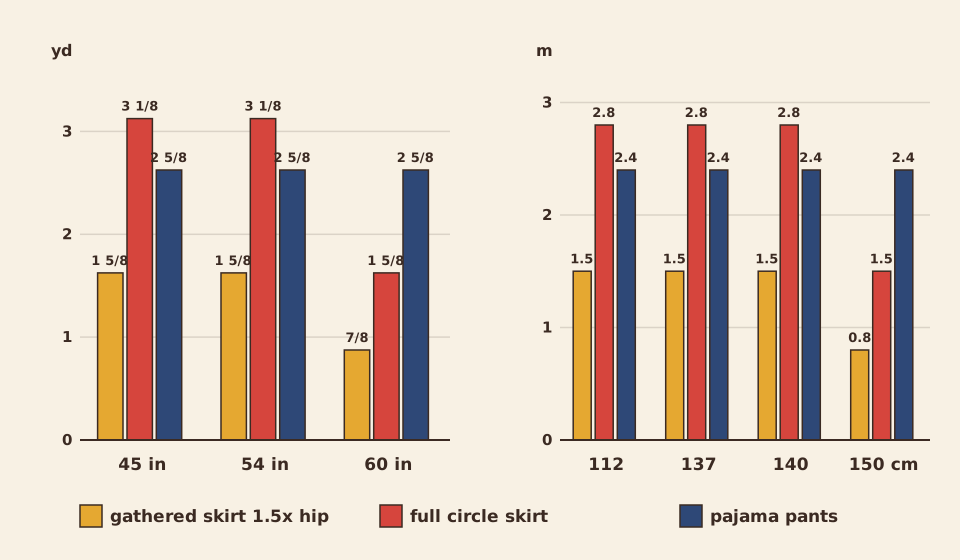
| Gathered skirt, 1.5 x hip, knee length | 1 5/8 yd | 1 5/8 yd | 7/8 yd | 1.5 m | 1.5 m | 1.5 m | 0.8 m |
| Gathered skirt, 2 x hip, knee length | 1 5/8 yd | 1 5/8 yd | 1 5/8 yd | 1.5 m | 1.5 m | 1.5 m | 1.5 m |
| Half circle skirt, knee length | 1 7/8 yd | 1 7/8 yd | 1 7/8 yd | 1.7 m | 1.7 m | 1.7 m | 1.7 m |
| Full circle skirt, knee length | 3 1/8 yd | 3 1/8 yd | 1 5/8 yd | 2.8 m | 2.8 m | 2.8 m | 1.5 m |
| Pajama pants, elastic waist | 2 5/8 yd | 2 5/8 yd | 2 5/8 yd | 2.4 m | 2.4 m | 2.4 m | 2.4 m |
| Sleeveless dress, gathered skirt | 2 1/8 yd | 2 1/8 yd | 2 1/8 yd | 1.9 m | 1.9 m | 1.9 m | 1.9 m |
Usable widths after selvages: 42 in (45 in bolt), 52 in (54 in), 58 in (60 in), and 107, 132, 135 and 145 cm. Measure your own bolt, because usable width varies.
What went into each row, so you can adjust for your body:
- Skirts: finished length 24 in (60 cm), elastic casing 2 in (5 cm), hem 1 1/4 in (3 cm), seams 5/8 in (1.5 cm). The 1.5 x skirt has two panels of 28 1/4 x 27 1/4 in (72 x 68 cm); the 2 x skirt two panels of 37 1/4 x 27 1/4 in (95 x 68 cm).
- Circle skirts: finished length 22 in (55 cm), narrow hem 1/2 in (1 cm), cut as quarter circles with side seams.
- Pajama pants: loose fit with 6 in (15 cm) ease at the hip, outside leg 41 3/4 in (106 cm). Each front piece fits a rectangle of about 14 x 45 in (35.5 x 114 cm), each back about 16 1/4 x 45 in (41 x 114 cm).
- Dress: the 2 x gathered skirt (24 in or 60 cm long) plus a bodice front cut on the fold (11 x 19 in, 28 x 48 cm) and two bodice backs (10 x 18 in, 25.5 x 46 cm).
- Not included: shrinkage from prewashing, matching plaids, and one way layouts. Add those below.
Why wider fabric sometimes changes nothing
Look at the table again. Wider fabric only saves length when two pieces that used to sit one above the other can now sit side by side.
- The 1.5 x gathered skirt panel is 28 1/4 in wide. Two of them need 56 1/2 in. That fits on a 60 in bolt (58 in usable), so the skirt drops from two lengths to one: 1 5/8 yd becomes 7/8 yd.
- The 2 x panel is 37 1/4 in wide. Two need 74 1/2 in, more than any dress fabric, so every width needs two lengths.
- Pajama pants are long and narrow. A front and a back together are 30 1/4 in wide, just over the 29 in a folded 60 in bolt gives you. So 60 in fabric still needs two leg lengths. Nesting the crotch curves can sometimes squeeze them closer; your envelope layout shows what the designer found.
- The full circle skirt is the dramatic one. Each quarter circle needs a square of about 27 3/8 in (68.2 cm in the metric example). A folded 60 in bolt is 29 in wide, so the quarters fit on the fold and the skirt takes two rows instead of four.
This is why a 45 to 60 inch conversion chart can never be exact. Width matters in jumps, not smoothly.
How to work out how much fabric you need: the method
- Measure every pattern piece at its widest and longest points, seam allowance included. Note how many of each you cut and which go on the fold.
- Know your usable width. Measure selvage to selvage and take off the selvages. Common widths are 44/45 in (112/114 cm), 54 in (137 cm), 58/60 in (147/150 cm), and the European 140 cm and 150 cm.
- Choose the layout. Folded (selvages together) halves the working width and cuts two mirror pieces at once. Single layer gives the full width for wide pieces such as skirt panels and circle quarters.
- Lay out the tallest pieces first, each starting a new row along the length. Fill the space beside them with narrower pieces that are no taller. Pieces cut on the fold need their own spot against the fold.
- Add up the row lengths. That is the length of fabric the pieces use.
- Add 3 in (5 cm) to straighten the cut end.
- Add shrinkage if you will prewash (see below).
- Round up to a purchasable cut: the next 1/8 yd (4 1/2 in, 11.4 cm) in the US and Canada, the next 10 cm in the UK, Europe, Australia and most of the world.
- Add for nap, one way prints and plaids if your fabric has them.
Paper on the floor works beautifully for this. Mark your usable width with masking tape, lay the pieces inside it and measure.
How many yards of fabric for a dress?
For a sleeveless dress with a gathered skirt in a Misses 12, the worked layout above needs 2 1/8 yd on 45, 54 or 60 in fabric (1.9 m on any width from 112 to 150 cm). Add sleeves, a longer skirt or a fuller skirt and it grows quickly: every extra row of pieces adds its full length.
For a commercial dress pattern, read the envelope's yardage chart: find your size column, then the row for your view and fabric width. Envelopes usually list a "with nap" amount for directional fabrics; use it when your fabric needs one way cutting.
How much fabric for a skirt?
Gathered and elastic waist skirts
The skirt is a pair of rectangles. Decide the fullness (1.5 x the hip suits medium weight cotton; 2 x looks lovely in lawn and rayon challis), then:
- Total width = hip x fullness. Split it into two panels and add 5/8 in (1.5 cm) seam allowance to each side.
- Cut length = finished length + casing + hem.
- If two panels fit across your usable width, buy one cut length. Otherwise buy two.
Imperial: hip 36 in, fullness 1.5. Total 54 in, so each panel is 27 + 1 1/4 = 28 1/4 in wide. Cut length 24 + 2 + 1 1/4 = 27 1/4 in. On 45 in fabric: two lengths, 54 1/2 in, plus 3 in = 57 1/2 in, buy 1 5/8 yd. On 60 in fabric: both panels fit across (56 1/2 in of 58 in), so 27 1/4 + 3 = 30 1/4 in, buy 7/8 yd.
Metric: hip 92 cm, fullness 1.5. Total 138 cm, so each panel is 69 + 3 = 72 cm wide. Cut length 60 + 5 + 3 = 68 cm. On 112 cm fabric: two lengths, 136 cm, plus 5 = 141 cm, buy 1.5 m. On 150 cm fabric: both panels fit across (144 cm of 145 cm), so 68 + 5 = 73 cm, buy 80 cm.
Circle skirt math
A circle skirt's waist is a circle whose circumference is your waist.
- Waist radius, full circle: r = waist / (2 x pi).
- Waist radius, half circle: r = waist / pi.
- Outer radius: R = r + finished length + hem.
- Cut the waist line at r minus your seam allowance, so the stitching line measures exactly your waist. Stay stitch it right away: it is mostly bias and stretches.
Imperial: waist 26 1/2 in. r = 26.5 / 6.2832 = 4.22 in, about 4 1/4 in. R = 4 1/4 + 22 + 1/2 = 26 3/4 in. Cut the waist at 4 1/4 minus 5/8 = 3 5/8 in. Each quarter circle with its side seam allowance needs a square of about 27 3/8 in.
- 60 in fabric, folded: the working width is 29 in, so two quarters cut on the fold (each opens into a half circle) stack in two rows: 54 3/4 + 3 = 57 3/4 in, buy 1 5/8 yd.
- 45 in fabric: a quarter does not fit across the fold, so cut four quarters single layer, one per row: 109 3/8 + 3 = 112 3/8 in, buy 3 1/8 yd.
Metric: waist 67 cm. r = 67 / 6.2832 = 10.7 cm. R = 10.7 + 55 + 1 = 66.7 cm. Cut the waist at 10.7 minus 1.5 = 9.2 cm. Each quarter with seam allowance needs a square of about 68.2 cm.
- 150 cm fabric, folded (72.5 cm working width): two rows, 136.3 + 5 = 141.3 cm, buy 1.5 m.
- 140 cm fabric, folded (67.5 cm working width): the quarter is 7 mm too wide, so you need four rows and 2.8 m. Shorten the skirt by 1 cm to 54 cm and the quarter (67.2 cm) fits the fold: 1.4 m. That is the kind of saving it pays to check before you cut.
How much fabric for pajama pants?
Pajama pants are length bound. Each leg piece is roughly as long as your outside leg plus casing and hem, and on most fabric widths a front and a back cannot sit side by side. Plan on two leg lengths plus about 3 in (5 cm).
Imperial: outside leg 41 3/4 in + casing 2 in + hem 1 1/4 in = 45 in per row. Two rows = 90 in, plus 3 in = 93 in, buy 2 5/8 yd.
Metric: outside leg 106 cm + casing 5 cm + hem 3 cm = 114 cm per row. Two rows = 228 cm, plus 5 = 233 cm, buy 2.4 m.
Taller than average? Add twice the extra leg length. Shorts? Use your shorts length in place of the outside leg.
45 vs 60 inch fabric conversion
When a pattern lists a yardage for one width and your fabric is another, the quick estimate is the area ratio:
new length = old length x old width / new width
Imperial: the envelope says 2 3/4 yd of 45 in; you have 60 in. 2 3/4 x 45 / 60 = 2.06 yd, so 2 1/8 yd is the ratio answer.
Metric: the envelope says 2.5 m of 112 cm; you have 150 cm. 2.5 x 112 / 150 = 1.87 m, so 1.9 m is the ratio answer.
Treat that as an estimate and round up generously. Our own table shows why:
- Pajama pants: 2 5/8 yd on 45 in. The ratio predicts 2 yd on 60 in. The layout still needs 2 5/8 yd, because the pieces do not fit side by side.
- 1.5 x gathered skirt: 1 5/8 yd on 45 in. The ratio predicts 1 1/4 yd on 60 in. The layout needs only 7/8 yd.
The ratio errs both ways. Lay out the pieces when the amount matters, and always buy extra for:
- Nap and pile (velvet, corduroy, velour, faux fur, brushed fleece, satin with a sheen): every piece must point the same way, so you cannot turn pieces end to end to tuck them in. Use the envelope's "with nap" amount.
- One way prints: the same rule as nap, for prints with an up and a down.
- Stripes and plaids: pieces must match at side seams and centre front. Allow at least one extra pattern repeat for each main piece length.
- Knits: cut with the greatest stretch going around the body, which fixes the direction of every piece.
Shrinkage: add it before you round up
Prewash fabric the way you will wash the finished garment, and buy enough for it to shrink. Typical first wash shrinkage:
| Fibre | Typical shrinkage |
|---|---|
| Cotton | 3 to 5 percent; up to 10 percent for gauze and loosely woven cloth |
| Linen | 3 to 6 percent, more on a first hot wash |
| Viscose (rayon) | 3 to 8 percent; challis and crepe can shrink more |
| Bamboo viscose | 3 to 6 percent |
| Modal, lyocell | 2 to 4 percent |
| Polyester, nylon | Under 1 percent |
| Wool | Felts with heat and agitation; steam to preshrink instead |
Imperial: the dress layout uses 73 1/2 in plus 3 in = 76 1/2 in. For cotton lawn, add 5 percent: 76 1/2 x 1.05 = about 80 3/8 in. Buy 2 1/4 yd (81 in) instead of 2 1/8 yd.
Metric: the dress uses 184 cm plus 5 = 189 cm. Add 5 percent: 189 x 1.05 = 198.5 cm. Buy 2.0 m instead of 1.9 m.
How to buy fabric: yards, metres and cuts
- North America: fabric is cut in 1/8 yd steps (4 1/2 in, 11.4 cm). 1 yd = 36 in = 91.44 cm.
- UK, Europe, Australia and most of the world: cut in 10 cm steps, sold by the metre. 1 m = 39 3/8 in, a little more than a yard.
- Never convert a purchase by swapping units one for one. 2 yd is 1.83 m; 2 m is 2 3/16 yd.
- Quilting cottons also come as fat quarters and precuts. Our fat quarter size guide explains the US and metric versions.
How much fabric for curtains?
Curtains follow the same logic with two extra numbers: the fullness of your heading tape (printed on the tape label, for example 2 to 2.5 x the track) and the cut drop.
- Flat width for each curtain = track x fullness / 2, plus side turnings.
- Widths = flat width / usable fabric width, rounded up (part widths can share a cut length).
- Cut drop = finished drop + hem + heading turnings, plus one pattern repeat per length for prints.
Worked example (SewNQuilt's lined curtains project): track 56 in (140 cm), drop 84 in (210 cm), tape fullness 2.5, 54 in (137 cm) fabric with 52 in (132 cm) usable. Each curtain is 56 x 2.5 / 2 + 4 = 74 in wide (175 + 10.4 = 185.4 cm): one full width plus a 23 in (55.8 cm) part width. The two part widths share one length, so you cut three lengths of 91 1/2 in (230 cm), allowing a 3 in (8 cm) double hem and 1 1/2 in (4 cm) at the top. 3 x 91 1/2 + 2 = 276 1/2 in: buy 7 3/4 yd. Metric: 3 x 230 + 5 = 695 cm: buy 7.0 m.
From garments to quilts
Quilts need their own math: tops are pieced from cut strips, backings are seamed panels, and binding is a long strip. If you sew both, the logic you just learned carries straight over. The quilt backing guide compares vertical, horizontal and 108 in wide backs, and the free quilt backing calculator does the panels for you. For binding, see how much binding for a quilt.
Mistakes and fixes
| Mistake | What happens | Fix |
|---|---|---|
| Using the bolt width instead of the usable width | Pieces you planned side by side do not fit | Measure between the selvages and subtract them |
| Converting 45 to 60 in by ratio alone | Too little for long pieces, too much for wide ones | Lay out the pieces or use a layout based estimator |
| Forgetting the with nap layout | Velvet or corduroy pieces shade differently | Buy the "with nap" amount and cut every piece one way |
| No shrinkage allowance | The garment is short after prewashing | Add the fibre's shrinkage percent before rounding |
| Rounding to the nearest cut instead of up | You are a few inches short | Always round up to the next 1/8 yd or 10 cm |
| Lengthening a pattern without adding fabric | The hem runs out | Add the extra length once for every row it affects (twice for pants) |
| Swapping yards and metres one for one | 2 m bought as "2 yd" leaves extra; 2 yd as "2 m" leaves you short | Convert: 1 yd = 91.44 cm |
| Plaids without a repeat allowance | Side seams do not match | Add at least one repeat per main piece length |
Let SewNQuilt do the fabric math
You now know the method. SewNQuilt does it for you in seconds. The Garment yardage calculator takes your pattern pieces (or loads them from a project), your fabric width and a folded or single layer layout, adds lining and interfacing, and gives you the amount to buy in yards and metres. Inchy walks you through it, and every number comes from SewNQuilt's own calculation engine, never from the AI.
Every SewNQuilt project already lists its fabric amounts in yards and metres. Tap once to add them to your shopping list, and check your fabric stash first: that linen you bought last spring might be exactly enough.
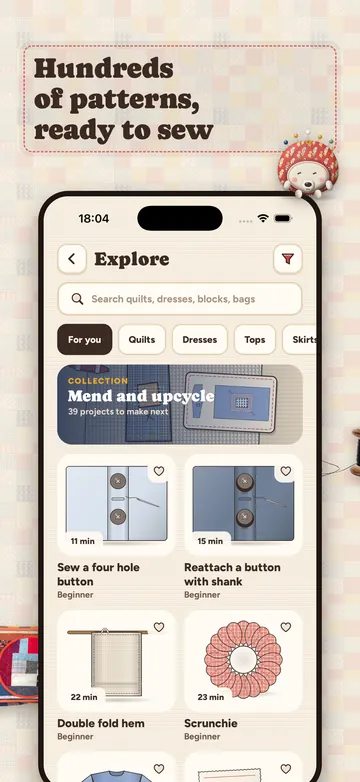
SewNQuilt Pro: weekly, monthly or yearly plans ($49.99 a year in the US). Get SewNQuilt and buy the right amount, every time.
FAQ
How do I calculate how much fabric I need for a project?
Lay the pattern pieces within your usable fabric width, measure the length they take, add 3 in (5 cm) for straightening and any shrinkage, then round up to the next 1/8 yd or 10 cm. If the envelope lists a yardage for your size, view and width, use that.
How many yards of fabric do I need for a dress?
It depends on the style, but a sleeveless dress with a gathered skirt in a Misses 12 takes about 2 1/8 yd (1.9 m). Sleeves, a longer or fuller skirt and a directional print all add more. For a commercial pattern, read the yardage on the envelope.
How much fabric do I need for pajama pants?
About two leg lengths plus 3 in (5 cm). For a Misses 12 with a 41 3/4 in (106 cm) outside leg, that is 2 5/8 yd (2.4 m), on 45 in and 60 in fabric alike, because the front and back pieces do not fit side by side.
How do I convert yardage from 45 in to 60 in fabric?
Multiply the yardage by 45 and divide by 60: 2 3/4 yd of 45 in becomes about 2 1/8 yd of 60 in. In metric, 2.5 m of 112 cm becomes about 1.9 m of 150 cm. It is an estimate, so round up and buy extra for nap, plaids and one way prints.
How much fabric for a circle skirt?
Find the waist radius (waist divided by 2 x pi), add the length and hem to get the outer radius, and lay out four quarter circles. A knee length full circle skirt for a 26 1/2 in waist needs 1 5/8 yd of 60 in fabric but 3 1/8 yd of 45 in fabric; in metric, 1.5 m of 150 cm or 2.8 m of 112 cm.
Should I buy extra fabric?
Buy for prewash shrinkage (3 to 5 percent for most cottons), for straightening the cut end, and for nap or pattern matching. A little extra also covers a recut sleeve, and leftovers become pockets, facings or patchwork.
Why does my pattern need less fabric on 60 in width?
Only when pieces that stacked on narrow fabric can sit side by side on the wider bolt. Long narrow pieces such as trouser legs often need the same length on every width.
Related guides
- How to take body measurements for sewingRead the guide
- Sewing pattern size chart: Big 4, Burda and OTTOBRERead the guide
- Seam allowance guideRead the guide
- Fat quarter sizeRead the guide
- How much fabric for quilt backingRead the guide
- Free toolsquilt backing calculator, seam allowance converterOpen the tool
Sources
All checked 31 October 2026.
- Simplicity size charts (Big 4 Misses body measurements used in the worked examples). Simplicity. https://simplicity.com/size-charts/
- Pattern Sizing and Body Measurements, McCall Pattern Company and Simplicity Creative Group (PDF). https://www.hobbycraft.co.uk/on/demandware.static/-/Library-Sites-hobbycraft-uk-content/default/images/brand/simplicity/hobbycraft_simplicity_measurement_chart.pdf
- OTTOBRE design size charts (outside leg for the pajama example). OTTOBRE design. https://www.ottobredesign.com/pages/size-charts
- Regulation (EU) No 1007/2011 on textile fibre names and labelling (fibre names). EUR-Lex. https://eur-lex.europa.eu/eli/reg/2011/1007/oj
- ISO 3758:2023, Textiles, care labelling code using symbols (prewash and care), via GINETEX. https://www.ginetex.net/GB/labelling/care-symbols.asp
- Yard and metre: 1 yd = 0.9144 m exactly, NIST Handbook 44 Appendix C, General Tables of Units of Measurement. National Institute of Standards and Technology. https://www.nist.gov/pml/owm/nist-handbook-44-current-edition
Image credits
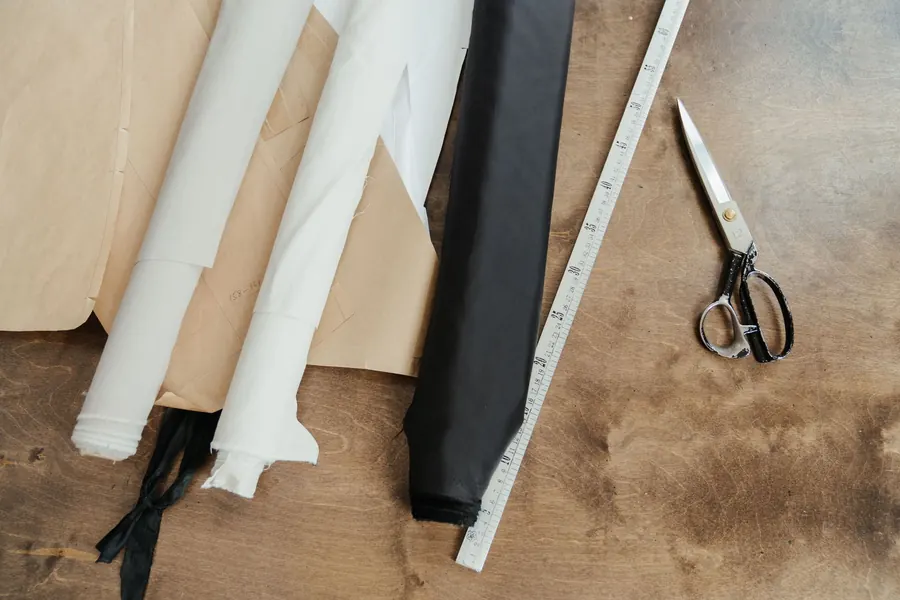
- Fabric rolls and pattern pieces on a cutting table: cottonbro studio on Pexels, https://www.pexels.com/photo/black-pants-on-brown-textile-4614224/ (ID 4614224), Pexels License.
- Chart: SewNQuilt, from the garment yardage engine's worked examples.
- Screenshot: the SewNQuilt app.