
Fat quarters are the sweets of the fabric shop: folded, stacked by colour and impossible to walk past. They are also the most misquoted size in quilting. Some pages online call a fat quarter 9 x 18 in (it is not), and most ignore the metric fat quarter that every shop outside North America sells. Here are the real sizes, side by side, what each piece yields, and every popular precut in both units.
Fat quarter size chart (US and metric)
| Cut | US (imperial) | Metric (UK, EU, AU, NZ) | How it is cut | Area |
|---|---|---|---|---|
| Fat quarter | about 18 x 21 to 22 in (46 x 53 to 56 cm) | about 50 x 55 cm (20 x 22 in) | half yard or half metre, cut in half at the fold | 378 to 396 sq in; metric 2,750 sq cm |
| Quarter yard (long quarter) | 9 in x width of fabric, about 9 x 42 to 44 in | 25 cm x width of fabric, about 25 x 110 cm | a strip across the bolt | the same as a fat quarter of that system |
| Fat eighth | about 9 x 21 to 22 in | about 25 x 55 cm in most metric shops | a fat quarter halved | half a fat quarter |
| Half yard / half metre | 18 in x width of fabric | 50 cm x width of fabric | a strip across the bolt | two fat quarters |
Why "about"? Quilting cotton is 42 to 44 in (107 to 112 cm) wide before the selvages come off, and each shop squares its cuts a little differently. Plan with a usable 18 x 21 in for a US fat quarter and 50 x 54 cm for a metric fat quarter. Those are the numbers our yield tables use.
A metric fat quarter holds about 8 to 13 percent more fabric than a US one. That matters when a US pattern is "fat quarter friendly": in metric shops you will have a little to spare, which is a lovely position to be in.
Fat eighths are where shops differ most. Most cut the fat quarter in half the long way (US about 9 x 21 to 22 in; metric about 25 x 55 cm), and some halve it the other way, giving a squarer piece of about 50 x 27.5 cm. Check the shop's listing before you plan a fat eighth project around one exact shape.
Fat quarter vs quarter yard: what is the difference?
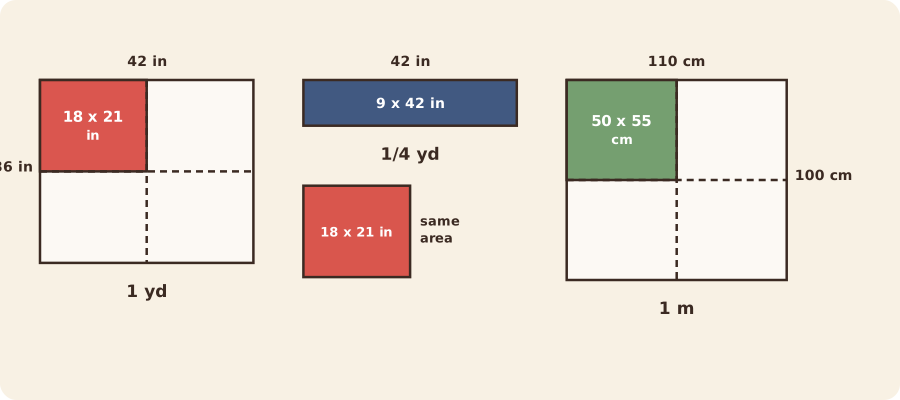
The fabric is the same amount. The shape is not.
- A quarter yard is 9 in (or 25 cm) cut straight across the bolt: a long, skinny 9 x 42 in strip.
- A fat quarter takes a half yard (18 in, or 50 cm in metric) and cuts it at the centre fold: a chunky 18 x 21 in rectangle.
The fat shape is far more useful for patchwork. A 9 in strip can never give you a 10 in square, or even two rows of 5 in squares. A fat quarter gives you twelve 5 in squares, or two 10 in squares. Long quarters win for one job: long pieces, such as border strips, sashing or a skinny row of binding.
Expert tip: when a pattern calls for "1/4 yd" of a fabric, it usually means a long quarter. When it says "1 fat quarter", it needs the fat shape. Swap them only after checking the cutting list.
What can you cut from a fat quarter?
These yields assume a usable 18 x 21 in (US) or 50 x 54 cm (metric) and straight cuts, checking both directions.
US fat quarter (usable 18 x 21 in)
| Cut size | Pieces per fat quarter |
|---|---|
| 10 in squares | 2 |
| 6 1/2 in squares | 6 |
| 6 in squares | 9 |
| 5 in squares | 12 |
| 4 1/2 in squares | 16 |
| 3 1/2 in squares | 30 |
| 2 1/2 in squares | 56 |
| 2 1/2 in strips | 7 strips 21 in long (or 8 strips 18 in long) |
Metric fat quarter (usable 50 x 54 cm)
| Cut size | Pieces per fat quarter |
|---|---|
| 21.5 cm squares | 4 |
| 16.5 cm squares | 9 |
| 12.5 cm squares | 16 |
| 11.5 cm squares | 16 |
| 9 cm squares | 30 |
| 6.5 cm squares | 56 |
| 6.5 cm strips | 7 strips 54 cm long (or 8 strips 50 cm long) |
The rule behind every number: pieces = (whole pieces across) x (whole pieces down), tried both ways round. For 5 in squares: 18 / 5 = 3 across, 21 / 5 = 4 down, 3 x 4 = 12.
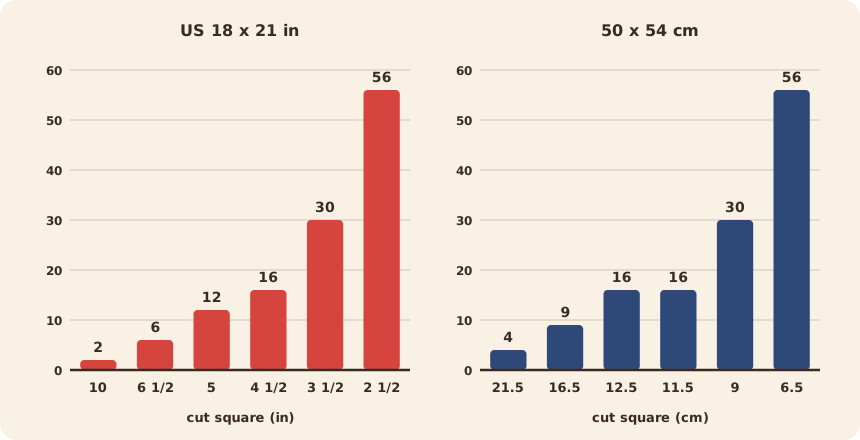
Two things jump out. First, 6 1/2 in squares are greedy: they fit only twice across 18 in and leave a 5 in strip behind, so you get 6. Cut 6 in squares instead and you get 9. Second, the slightly larger metric fat quarter shines at 16.5 cm squares, fitting nine where a US fat quarter fits only six 6 1/2 in squares of the same size.
Strips are friendly too. A US fat quarter cut the long way gives seven 2 1/2 x 21 in strips, about 132 in of binding after the diagonal joins, enough for a 30 in square mini quilt. A metric fat quarter gives seven 6.5 x 54 cm strips, about 339 cm after joins, enough for a 75 cm square mini quilt. For full size binding, see how much binding for a quilt.
How many fat quarters do I need for a quilt?
Four steps, and the math is kind.
- Pick the quilt size and the cut size of your squares or units. Our quilt sizes guide gives sizes for every bed.
- Count the pieces: across x down.
- Divide by the yield per fat quarter from the table above and round up.
- Add one or two for variety and for the cut that goes wrong. Every quilter has one.
Worked example in inches: a 60 x 72 in throw
Ten 6 in finished squares across and twelve down make a 60 x 72 in throw: 120 squares, cut 6 1/2 in.
- A US fat quarter gives 6 squares at 6 1/2 in.
- 120 / 6 = 20 fat quarters.
Now the expert move. Shrink the square to 5 1/2 in finished (cut 6 in) and the same 10 x 12 layout finishes at 55 x 66 in, still a cosy throw. Each fat quarter now gives 9 squares: 120 / 9 = 13.3, so 14 fat quarters. Six fewer fat quarters for 5 in less width. Size your block to your precut and your budget thanks you.
For comparison, the same 120 squares at 6 1/2 in from yardage: 6 squares per 40 in usable strip, 20 strips, 20 x 6 1/2 = 130 in, plus 3 in for straightening = 133 in. Buy 3 3/4 yd (135 in). Twenty fat quarters are 5 yd of fabric, so you pay a little for variety. It is usually worth it.
Worked example in centimetres: a 150 x 180 cm throw
Ten 15 cm finished squares across and twelve down: 120 squares, cut 16.5 cm (15 cm + 1.5 cm).
- A metric fat quarter (50 x 54 cm usable) gives 3 x 3 = 9 squares.
- 120 / 9 = 13.3, so 14 fat quarters.
From yardage: 6 squares per 102 cm usable strip, 20 strips, 20 x 16.5 = 330 cm, plus 5 cm = 335 cm. Buy 3.4 m. Fourteen metric fat quarters are 3.5 m of fabric, almost identical. In metric, a fat quarter quilt costs you very little extra fabric.
Fat quarters cover the top. Plan the backing, batting and binding separately; how to make a quilt walks through the whole order.
Precut sizes chart: charm pack, layer cake, jelly roll and more
Precuts are prepared fabric pieces sold in bundles, usually one or two of every print in a collection. The sizes below are the standard cuts; counts vary by maker and line.
| Precut | Size (inches) | Size (cm) | Typical count | Fabric equivalent, 42 in wide | Metric equivalent, 107 cm wide |
|---|---|---|---|---|---|
| Charm pack | 5 x 5 in | 12.7 x 12.7 cm | 42 | 25 in (about 2/3 yd) | 0.63 m |
| Mini charm pack | 2 1/2 x 2 1/2 in | 6.35 x 6.35 cm | 42 | 6 1/4 in | 0.16 m |
| Layer cake | 10 x 10 in | 25.4 x 25.4 cm | 42 | 100 in (about 2 3/4 yd) | 2.53 m |
| Jelly roll | 2 1/2 in x width of fabric (about 42 to 44 in) | 6.35 cm x width of fabric (about 107 to 112 cm) | 40 | 100 in (about 2 3/4 yd) | 2.53 m |
| Honey bun | 1 1/2 in x width of fabric | 3.8 cm x width of fabric | 40 | 60 in (1 2/3 yd) | 1.52 m |
| Dessert roll | 5 in x width of fabric | 12.7 cm x width of fabric | 20 | 100 in (about 2 3/4 yd) | 2.53 m |
| Turnover | most often 6 in squares cut once on the diagonal | most often 15.2 cm squares cut once on the diagonal | often 80 triangles | about 34 in (just under 1 yd) | 0.87 m |
| Fat quarter | about 18 x 22 in | about 50 x 55 cm (metric cut) | 1 | about 9 1/2 in (1/4 yd) | 0.24 m |
| Long quarter | 9 in x width of fabric | 25 cm x width of fabric | 1 | 9 in (1/4 yd) | 0.23 m |
The equivalents are fabric area, so they tell you how much fabric is in the bundle, not how much yardage you would buy to cut the same pieces (cutting always leaves a little behind). Turnovers vary most between collections; some lines use 5 in squares, so check the listing for the size and count.
What each precut does best:
- Charm pack: 42 squares make a 6 x 7 grid of 4 1/2 in finished squares, a 27 x 31 1/2 in baby or mini quilt. Pairs make 2 at a time HSTs that trim to 4 in finished; see the half square triangle chart.
- Layer cake: 42 squares sewn as plain squares (9 1/2 in finished) make a 57 x 66 1/2 in throw in a 6 x 7 layout. Pairs sewn 8 at a time give eight HSTs that trim to 4 in finished.
- Jelly roll: strip quilts, log cabin, rail fence and scrappy binding. A classic jelly roll race quilt finishes around 50 x 64 in.
- Honey bun: skinny logs (1 in finished), sashing and string quilts.
- Dessert roll: 5 in strips, eight 5 in squares per strip.
Precut brand names
Charm Pack, Layer Cake, Jelly Roll, Honey Bun, Dessert Roll and Turnover are Moda Fabrics product names (Moda also calls its mini charm packs Candy). Other makers sell the same cuts under their own names:
| Generic cut | Moda | Robert Kaufman | Riley Blake |
|---|---|---|---|
| 5 in squares | Charm Pack | Charm Squares | 5 in Stacker |
| 10 in squares | Layer Cake | Ten Squares | 10 in Stacker |
| 2 1/2 in strips | Jelly Roll | Roll Up | Rolie Polie |
Other makers have their own names too. When a pattern names a brand, think of the generic size and any maker's bundle will work, as long as the count is enough.
How do you measure a precut with pinked edges?
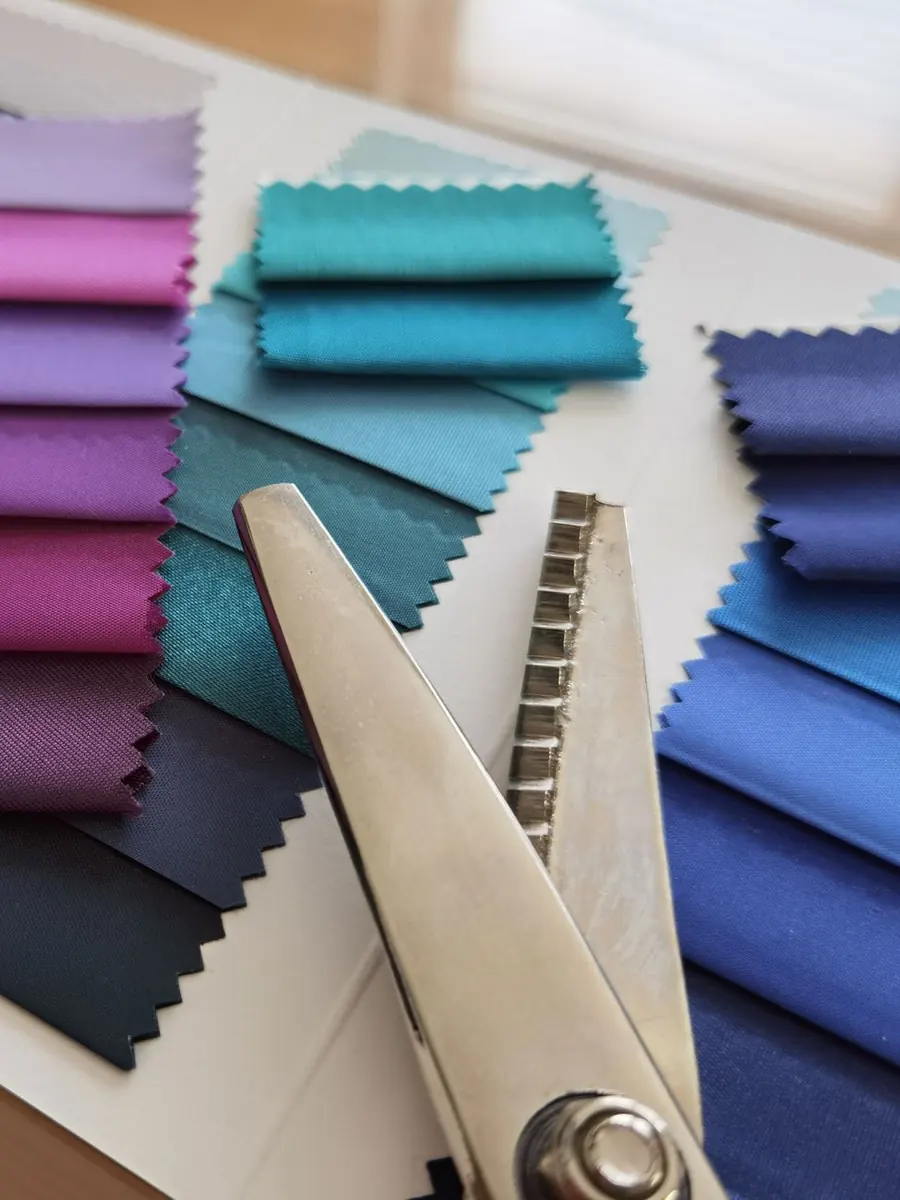
Most precuts are cut with pinking blades so the edges fray less. Measure from the outer points of the zigzag, not the valleys. Most patterns written for precuts set the 1/4 in seam from those points. If you measure from the valleys, your charm square suddenly looks 1/8 in short and you start trimming fabric that was perfect all along.
Should you prewash fat quarters and precuts?
Skip it for precuts. Small pieces fray, shrink unevenly and twist out of square in the wash, and a 2 1/2 in strip can lose a real share of its width. Sew them as they come and add a colour catcher sheet to the first wash of the finished quilt.
Fat quarters are a judgement call. Most quilters skip prewashing them too. If a fat quarter is a deep red, indigo, batik or hand dye that you plan to sit beside white, test a snippet for colour bleeding first. If you do wash one, wash all the fabrics in the project, and expect to lose a little size, since cotton can shrink a few percent.
Fat quarters for sewing, not only quilts
Fat quarters are a gift to garment and accessory sewists too. One fat quarter covers a zip pouch with lining, a few scrunchies, a pair of pocket linings or a tidy run of bias binding for a neckline. Bundles are an easy way to get coordinated prints for small makes without buying a half yard of each.
Fat quarter mistakes and fixes
- Planning with 18 x 22 in. After selvages and squaring, assume 18 x 21 in. Plan with 22 in and the last row of squares comes up short.
- Buying a long quarter for a fat quarter pattern. Same area, wrong shape. A 9 in strip will not give 10 in squares.
- Following a US yield in a metric shop (or the reverse). A metric fat quarter is larger, so US counts are safe, and metric counts can be too generous for a US piece.
- Choosing a cut size that wastes a strip. 6 1/2 in squares leave 5 in unused across a US fat quarter. Check the yield table and adjust the block size where you can.
- Measuring pinked edges from the valleys. Measure from the outer points.
- Assuming every bundle has 42 pieces. Charm packs range from 30 to 42 squares by brand. Count before you cut.
- Prewashing precuts. Keep them as they come.
Precuts, stash and yardage in SewNQuilt
You bought the bundle. Now let us use it well. Tell SewNQuilt's Precuts calculator the piece you want to cut and how many you need. It tells you how many fat quarters, charm packs, layer cakes or jelly rolls to grab, with the spares, in inches or centimetres. Buying off the bolt instead? Yardage for cut pieces works out the fabric for any cut list. And your fabric stash has a precut category with counts, so the fat quarter bundle on your shelf is right there when you plan the next quilt. Pip knows your stash too, so ask what it could become.
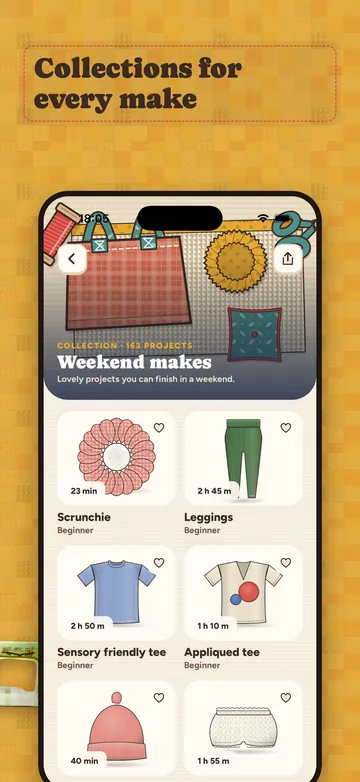
Prefer a small make first? The Weekend makes collection is full of projects that love a fat quarter.
FAQ
How big is a fat quarter in inches?
A US fat quarter is about 18 x 21 to 22 in: a half yard cut in half at the fold. Plan with a usable 18 x 21 in after the selvages are trimmed.
How big is a fat quarter in cm?
A metric fat quarter, sold in the UK, Europe, Australia and New Zealand, is about 50 x 55 cm: a half metre cut in half at the fold. A US fat quarter measures about 46 x 53 to 56 cm.
Is a fat quarter the same as a quarter yard?
It is the same amount of fabric in a different shape. A quarter yard is a 9 x 42 in strip; a fat quarter is an 18 x 21 in rectangle, which is far more useful for cutting squares.
How many 5 inch squares can I cut from a fat quarter?
Twelve, from a usable 18 x 21 in (3 across, 4 down). You get sixteen 4 1/2 in squares, thirty 3 1/2 in squares or fifty six 2 1/2 in squares.
How many fat quarters do I need for a throw quilt?
About 14 to 20, depending on your square size. A 60 x 72 in throw of 6 in finished squares needs 20 US fat quarters; the same layout with 5 1/2 in finished squares needs 14. A 150 x 180 cm throw of 15 cm finished squares needs 14 metric fat quarters.
What size is a jelly roll strip?
A jelly roll strip is 2 1/2 in (6.35 cm) wide and the width of the fabric long, about 42 to 44 in (107 to 112 cm). A standard jelly roll has 40 strips.
What is the difference between a charm pack and a layer cake?
A charm pack holds 5 in (12.7 cm) squares and a layer cake holds 10 in (25.4 cm) squares, usually 42 of each. A layer cake holds four times the fabric of a charm pack.
Should I prewash precuts?
No. Precuts fray and shrink unevenly when washed. Sew them as they come and use a colour catcher in the first wash of the finished quilt.
Related guides
Sources
- Moda Fabrics, precut sizes and counts, https://my.modafabrics.com/node/29570, checked 31 Oct 2026.
- Cotton Patch (UK), Moda jelly rolls and precuts FAQ, https://www.cottonpatch.co.uk/moda-jelly-rolls-faq, checked 31 Oct 2026.
- Pelenna Patchworks (UK), fat quarter and precut sizes, https://www.pelennapatchworks.co.uk/moda-jelly-rolls-layer-cakes.html, checked 31 Oct 2026.
- Missouri Star Quilt Co., turnover precuts, https://www.missouriquiltco.com/blogs/missouri-star-quilting-tutorials/a-quick-turnover-tip-for-turnover-week, checked 31 Oct 2026.
- Echidna Sewing (Australia), imperial to metric conversion guide (metric fat quarter), https://www.echidnasewing.com.au/article/inspiring-and-educating/imperial-to-metric-conversion-guide/, checked 31 Oct 2026.
- National Institute of Standards and Technology (NIST), SI units: length (1 yd = 0.9144 m exactly), https://www.nist.gov/pml/owm/si-units-length, checked 31 Oct 2026.
Image credits
- Vero Lova on Pexels, ID 33830661, https://www.pexels.com/photo/colorful-fabric-swatches-with-pinking-shears-33830661/
- Diagram and chart: SewNQuilt, built from the values on this page.
- Screenshot: SewNQuilt app (real screenshot).