

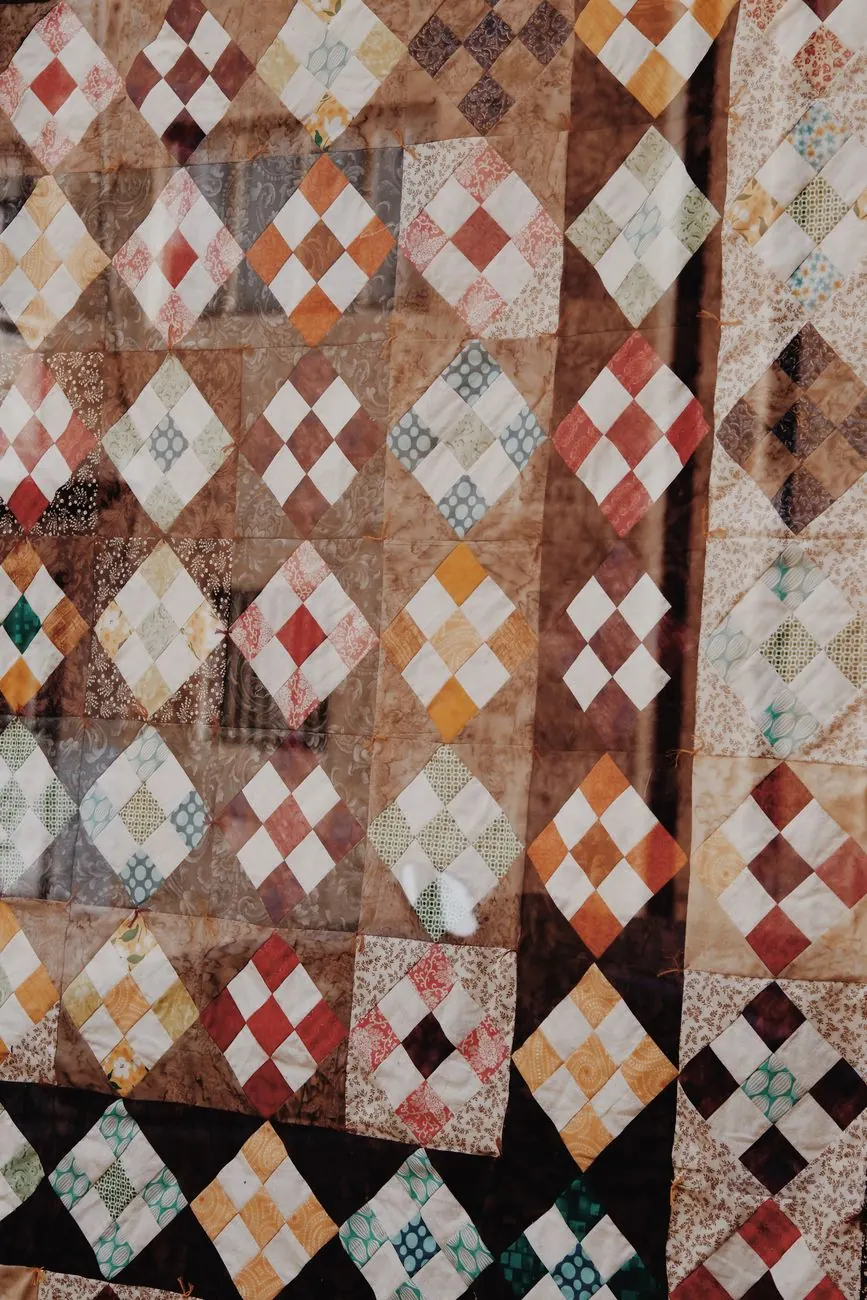
The half square triangle is the workhorse of patchwork. Turn it one way and you get a pinwheel. Turn it again and you have a chevron, a star point, a sawtooth border, a whole Ocean Waves quilt. Because you make so many of them, a tiny error in the cut size gets multiplied by every unit in the quilt. This chart gives you every common method in one place, in both measuring systems, with the reasoning behind each number so you can trust it and work out any size that is missing.
The half square triangle chart (inches)
Finished means the size of the HST inside the quilt, after it is sewn to its neighbours. Unfinished (the trim size) is finished + 1/2 in. Every cut below is a square, and every method uses one light and one dark square per pair.
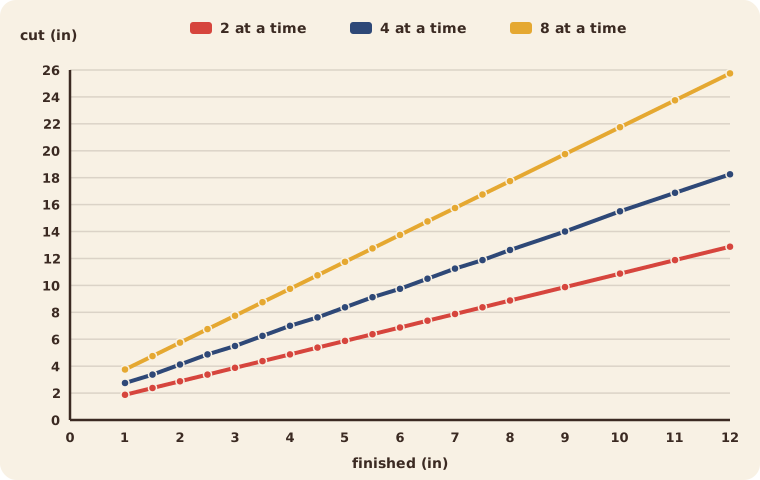
| Finished HST | Trim to (unfinished) | 2 at a time: cut 2 squares | 4 at a time: cut 2 squares | 8 at a time: cut 2 squares | Oversize and trim: cut 2 squares |
|---|---|---|---|---|---|
| 1 in | 1 1/2 in | 1 7/8 in | 2 3/4 in | 3 3/4 in | 2 in |
| 1 1/2 in | 2 in | 2 3/8 in | 3 3/8 in | 4 3/4 in | 2 1/2 in |
| 2 in | 2 1/2 in | 2 7/8 in | 4 1/8 in | 5 3/4 in | 3 in |
| 2 1/2 in | 3 in | 3 3/8 in | 4 7/8 in | 6 3/4 in | 3 1/2 in |
| 3 in | 3 1/2 in | 3 7/8 in | 5 1/2 in | 7 3/4 in | 4 in |
| 3 1/2 in | 4 in | 4 3/8 in | 6 1/4 in | 8 3/4 in | 4 1/2 in |
| 4 in | 4 1/2 in | 4 7/8 in | 7 in | 9 3/4 in | 5 in |
| 4 1/2 in | 5 in | 5 3/8 in | 7 5/8 in | 10 3/4 in | 5 1/2 in |
| 5 in | 5 1/2 in | 5 7/8 in | 8 3/8 in | 11 3/4 in | 6 in |
| 5 1/2 in | 6 in | 6 3/8 in | 9 1/8 in | 12 3/4 in | 6 1/2 in |
| 6 in | 6 1/2 in | 6 7/8 in | 9 3/4 in | 13 3/4 in | 7 in |
| 6 1/2 in | 7 in | 7 3/8 in | 10 1/2 in | 14 3/4 in | 7 1/2 in |
| 7 in | 7 1/2 in | 7 7/8 in | 11 1/4 in | 15 3/4 in | 8 in |
| 7 1/2 in | 8 in | 8 3/8 in | 11 7/8 in | 16 3/4 in | 8 1/2 in |
| 8 in | 8 1/2 in | 8 7/8 in | 12 5/8 in | 17 3/4 in | 9 in |
| 9 in | 9 1/2 in | 9 7/8 in | 14 in | 19 3/4 in | 10 in |
| 10 in | 10 1/2 in | 10 7/8 in | 15 1/2 in | 21 3/4 in | 11 in |
| 11 in | 11 1/2 in | 11 7/8 in | 16 7/8 in | 23 3/4 in | 12 in |
| 12 in | 12 1/2 in | 12 7/8 in | 18 1/4 in | 25 3/4 in | 13 in |
Yield per pair of squares: 2 at a time makes 2 HSTs, 4 at a time makes 4, 8 at a time makes 8, oversize and trim makes 2.
The formulas, so you can extend the chart:
- 2 at a time: finished + 7/8 in.
- 4 at a time: (finished + 7/8 in) x 1.414, rounded up to the next 1/8 in.
- 8 at a time: 2 x (finished + 7/8 in).
- Oversize and trim: finished + 1 in, then trim each unit to finished + 1/2 in. Many quilters go up to finished + 1 1/2 in for extra room.
The half square triangle chart (centimetres)
Metric quilters sew a 0.75 cm seam, so the metric chart is computed from scratch, never converted from inches. The HST allowance becomes 2.6 cm, and the trim size is finished + 1.5 cm. Cuts round up to the next millimetre.
| Finished HST | Trim to (unfinished) | 2 at a time | 4 at a time | 8 at a time | Oversize and trim |
|---|---|---|---|---|---|
| 4 cm | 5.5 cm | 6.6 cm | 9.4 cm | 13.2 cm | 7 cm |
| 5 cm | 6.5 cm | 7.6 cm | 10.8 cm | 15.2 cm | 8 cm |
| 6 cm | 7.5 cm | 8.6 cm | 12.2 cm | 17.2 cm | 9 cm |
| 7 cm | 8.5 cm | 9.6 cm | 13.6 cm | 19.2 cm | 10 cm |
| 8 cm | 9.5 cm | 10.6 cm | 15 cm | 21.2 cm | 11 cm |
| 9 cm | 10.5 cm | 11.6 cm | 16.5 cm | 23.2 cm | 12 cm |
| 10 cm | 11.5 cm | 12.6 cm | 17.9 cm | 25.2 cm | 13 cm |
| 11 cm | 12.5 cm | 13.6 cm | 19.3 cm | 27.2 cm | 14 cm |
| 12 cm | 13.5 cm | 14.6 cm | 20.7 cm | 29.2 cm | 15 cm |
| 13 cm | 14.5 cm | 15.6 cm | 22.1 cm | 31.2 cm | 16 cm |
| 14 cm | 15.5 cm | 16.6 cm | 23.5 cm | 33.2 cm | 17 cm |
| 15 cm | 16.5 cm | 17.6 cm | 24.9 cm | 35.2 cm | 18 cm |
| 16 cm | 17.5 cm | 18.6 cm | 26.4 cm | 37.2 cm | 19 cm |
| 17 cm | 18.5 cm | 19.6 cm | 27.8 cm | 39.2 cm | 20 cm |
| 18 cm | 19.5 cm | 20.6 cm | 29.2 cm | 41.2 cm | 21 cm |
| 19 cm | 20.5 cm | 21.6 cm | 30.6 cm | 43.2 cm | 22 cm |
| 20 cm | 21.5 cm | 22.6 cm | 32 cm | 45.2 cm | 23 cm |
Metric formulas: 2 at a time = finished + 2.6 cm. 4 at a time = (finished + 2.6 cm) x 1.414, rounded up to the next millimetre. 8 at a time = 2 x (finished + 2.6 cm). Oversize = finished + 3 cm, trimmed to finished + 1.5 cm.
Why do you add 7/8 in to a half square triangle?
Squares get finished + 1/2 in, because each of the two edges gains a 1/4 in seam allowance. Triangles need more, because one of their seams runs on the diagonal.
Picture the finished triangle with two legs of length f. The two straight legs each gain a 1/4 in allowance, just like a square. The long diagonal edge also gains a 1/4 in allowance, but that allowance is measured at 90 degrees to the diagonal. Where the extended diagonal meets each leg, it has travelled 1/4 in x 1.414 = 0.354 in further along the leg. Add it up:
leg of the cut triangle = f + 1/4 + 1/4 + 0.354 = f + 0.854 in
That is the formula s x (2 + sqrt 2), with s = 1/4 in. A rotary ruler is marked in 1/8 in, so 0.854 in rounds up to 7/8 in. That tiny extra (about 1/50 in) is a gift: your HSTs come out a hair large, which is exactly what you want before a final press and a tidy trim. This is the whole "HST 7/8 rule".
In metric the seam is 0.75 cm, so the exact allowance is 0.75 x 3.414 = 2.56 cm, used as 2.6 cm. That is why a metric pattern never says "finished + 2.2 cm" (the straight conversion of 7/8 in). The seam is different, so the number is different.
Where does 1.414 come from in the 4 at a time method?
In the 4 at a time method you sew around the outside of the square and cut on both diagonals. The edges of each HST are half diagonals of the big square, so the big square must be the 2 at a time size times the square root of 2 (1.414). Then round up to a line you can cut on your ruler. Some charts compute this from the exact 0.854 in instead of 7/8 in and land 1/8 in smaller on a few sizes (for example 6 7/8 in instead of 7 in for a 4 in HST). We print the larger, rounded up number because 4 at a time units have stretchy bias edges, and a whisker of extra fabric to trim is far kinder than a unit that comes up short.
Why is 8 at a time simply double?
Draw both diagonals on a square that is 2 x (finished + 7/8 in), sew 1/4 in on both sides of each diagonal, then cut it in half vertically and horizontally first. You now hold four squares of exactly finished + 7/8 in, each already sewn like a 2 at a time pair. Cut each on its diagonal and you have eight HSTs. The 8 at a time chart is the 2 at a time chart, four times over, in one square.
How do you make half square triangles 2 at a time?
This is the method every quilting teacher starts with, and for good reason: straight grain on the outer edges, easy to mark, very accurate.
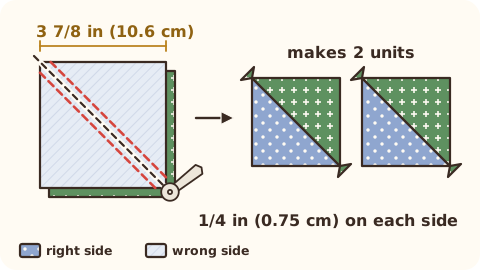
- Cut. Cut one light and one dark square at finished + 7/8 in (metric: + 2.6 cm). For 3 in finished HSTs, that is 3 7/8 in (for 8 cm finished, 10.6 cm).
- Mark. Draw a diagonal line corner to corner on the wrong side of the light square with a fine pencil or a fabric pen.
- Layer. Place the squares right sides together, edges aligned, and pin away from the line.
- Sew. Stitch exactly 1/4 in (0.75 cm) from the line on both sides. A 1/4 in foot rides the drawn line nicely. Keep your stitch length at 2.0 to 2.2 mm.
- Cut apart. Rotary cut on the drawn line. You now have two HSTs.
- Press. Set the seam first, then press it to the dark side or open (see below). Press, do not iron.
- Trim. Trim the two little tails (dog ears) and check the unit: it should measure finished + 1/2 in, so 3 1/2 in (9.5 cm).
Example: a Churn Dash at 12 in has four 4 in finished HST corners. Four HSTs need two pairs, so cut 2 light and 2 dark squares at 4 7/8 in.
How do you make HSTs 4 at a time?
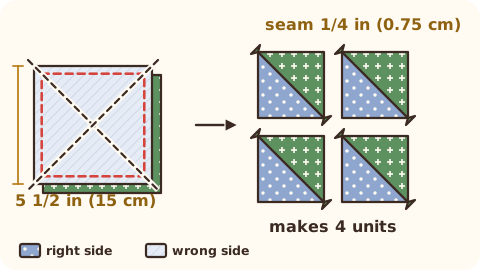
- Cut one light and one dark square at the 4 at a time size from the chart (3 in finished: 5 1/2 in; 8 cm finished: 15 cm).
- Layer them right sides together. No marking needed for the seams.
- Sew 1/4 in (0.75 cm) around all four edges.
- Cut on both diagonals. Four HSTs fall out.
- Press gently and trim to finished + 1/2 in.
The bias warning. The outside edges of every 4 at a time unit are cut on the bias, the stretchiest direction of woven fabric. They grow if you tug them, iron back and forth, or handle them a lot. Starch or use a starch alternative on both squares before cutting, press with an up and down motion, and trim each unit square. Use 4 at a time where the HST edges will be sewn to straight grain pieces, and avoid it on the outer edge of a quilt. When you want a little extra security, cut the squares 1/4 in (0.5 cm) larger and trim.
How do you make HSTs 8 at a time?
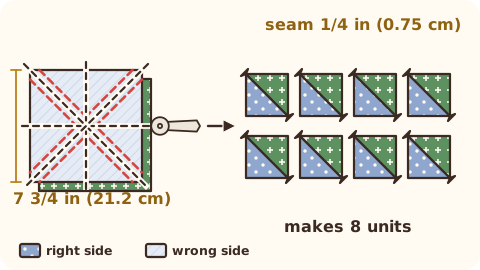
- Cut one light and one dark square at 2 x (finished + 7/8 in). For a 3 in HST that is 7 3/4 in; for 4 in, 9 3/4 in; for 8 cm, 21.2 cm.
- Draw both diagonals on the wrong side of the light square.
- Layer right sides together and sew 1/4 in on both sides of both diagonals: four seams.
- Cut the square in half vertically and horizontally, then cut each smaller square on its drawn diagonal.
- Press and trim. Eight HSTs, straight grain on the outside edges.
This is the speed method for big HST quilts. A 10 in layer cake square happens to fit it beautifully: 10 in = 2 x (4 1/8 + 7/8), so a pair of layer cake squares gives eight HSTs that trim to 4 in finished (4 1/2 in unfinished).
Oversize and trim: the accuracy method
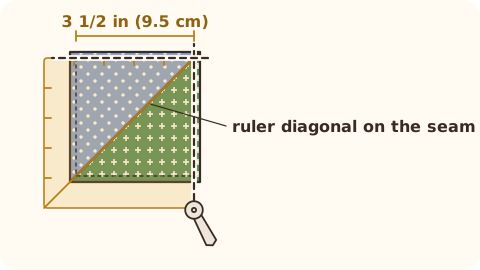
Cut your squares at finished + 1 in (metric: + 3 cm), sew them 2 at a time, press, then trim every unit to finished + 1/2 in (+ 1.5 cm).
How to trim well:
- Lay a square ruler on the HST with its 45 degree line exactly on the seam.
- Position it so the HST extends a little past the trim measurement on the top and right edges. Trim those two sides.
- Rotate the unit 180 degrees. Line up the freshly cut edges with the trim measurement on the ruler, keep the 45 degree line on the seam, and trim the other two sides.
A dedicated HST trimming ruler speeds this up, but any square ruler with a diagonal line works. Yes, trimming takes time. For points that must meet perfectly in a star or a Bear's Paw, it is time well spent.
Pressing: open or to the side?
Both are correct. Choose by what the block needs.
- To the dark side (the traditional choice): the dark fabric hides the seam allowance, the seams nest against neighbouring units, and the seam is a touch stronger for hand quilting.
- Open: the flattest HST, and the easiest to trim accurately because the diagonal seam sits dead centre. Best for small HSTs (2 in or less, 5 cm or less), blocks where many points meet, and modern quilts. Shorten your stitch to 1.8 to 2.0 mm so the open seam stays closed.
Always set the seam first (press it flat as sewn), then open the unit and press. Lift and lower the iron. Sliding an iron along a diagonal seam stretches it out of square.
HST yield planning: how many pairs for N units?
The formula is one line: pairs = N divided by the yield per pair, rounded up.
| You need | 2 at a time (2 per pair) | 4 at a time (4 per pair) | 8 at a time (8 per pair) |
|---|---|---|---|
| 8 HSTs | 4 pairs | 2 pairs | 1 pair |
| 16 HSTs | 8 pairs | 4 pairs | 2 pairs |
| 48 HSTs | 24 pairs | 12 pairs | 6 pairs |
| 100 HSTs | 50 pairs | 25 pairs | 13 pairs (4 spare) |
One pair is one light square plus one dark square, so double the pairs to get the total squares you cut.
Worked example in inches: 48 HSTs at 3 in finished
Your fabric gives 40 in of usable width after the selvages (42 to 44 in quilting cotton).
- 2 at a time: 24 squares of each colour at 3 7/8 in. Ten fit across a strip (40 / 3 7/8 = 10.3), so you need 3 strips: 3 x 3 7/8 = 11 5/8 in of each fabric.
- 4 at a time: 12 squares of each colour at 5 1/2 in. Seven per strip, so 2 strips: 11 in of each fabric.
- 8 at a time: 6 squares of each colour at 7 3/4 in. Five per strip, so 2 strips: 15 1/2 in of each fabric. The sixth square costs a whole second strip. If 40 HSTs (5 pairs) will do, one strip covers it.
Add 2 to 4 in for straightening, then round up to a buyable cut: 1/2 yd of each fabric covers 2 or 4 at a time, and 5/8 yd covers 8 at a time.
Worked example in centimetres: 48 HSTs at 8 cm finished
Usable width is 102 cm.
- 2 at a time: 24 squares of each colour at 10.6 cm, 9 per strip, 3 strips: 31.8 cm of each fabric.
- 4 at a time: 12 squares at 15 cm, 6 per strip, 2 strips: 30 cm.
- 8 at a time: 6 squares at 21.2 cm, 4 per strip, 2 strips: 42.4 cm.
Add 5 to 10 cm for straightening and round up to the next 10 cm: 50 cm of each fabric covers 2 or 4 at a time, and 60 cm covers 8 at a time.
Which HST method is best? A side by side comparison
| Method | Cut size (3 in finished) | HSTs per pair | Seams per HST | Outer edges | Fabric per HST (both fabrics) | Best for |
|---|---|---|---|---|---|---|
| 2 at a time | 3 7/8 in (8 cm: 10.6 cm) | 2 | 1 | straight grain | 15.0 sq in | beginners, mixed scrappy pairs, any quilt |
| 4 at a time | 5 1/2 in (8 cm: 15 cm) | 4 | 1 | bias | 15.1 sq in | speed with two fabrics, interior units |
| 8 at a time | 7 3/4 in (8 cm: 21.2 cm) | 8 | 1/2 | straight grain | 15.0 sq in | large quilts, layer cakes, matching sets |
| Oversize and trim | 4 in (8 cm: 11 cm) | 2 | 1 | straight grain | 16.0 sq in | perfect points, stars, competition work |
Here is the surprise the numbers show: the first three methods use almost exactly the same fabric per HST. Speed is the real difference. 8 at a time halves the sewing per unit and keeps the grain friendly; 4 at a time is fast but trades accuracy for bias edges; oversize and trim spends roughly 6 to 7 percent more fabric to buy you perfect units. Our advice for a first HST quilt: 2 at a time with a 1/8 in oversize, trimmed. You learn the unit, and every unit comes out true.
HST mistakes and how to fix them
- HSTs finish 1/8 in small. Your seam is a little wide. Sew a scant 1/4 in (a thread or two inside the line) and do the quarter inch test: three 1 1/2 x 3 1/2 in strips sewn together must measure 3 1/2 in wide (metric: three 4 x 9 cm strips measure 9 cm).
- Wavy or stretched units. Bias edges were ironed back and forth. Starch before cutting, press straight down, and trim square with the diagonal on the seam.
- Using a chart from another seam system. An inch chart sewn with a 0.75 cm seam (or a metric chart sewn with a 1/4 in foot) drifts on every unit. Plan the whole quilt in one system.
- Rounding 4 at a time down. If your calculator shows 5.48, cut 5 1/2 in, never 5 3/8 in. Round up, then trim.
- Trimming with the ruler off the seam. The 45 degree line must sit on the seam, not near it. A HST trimmed off the diagonal gives blunt points.
- Pressing to the light side. The dark allowance shadows through. Press to the dark side, or press open.
- Dog ears left on. Those tails throw off alignment when you join rows. Snip them before sewing units together.
Let SewNQuilt do the triangle math
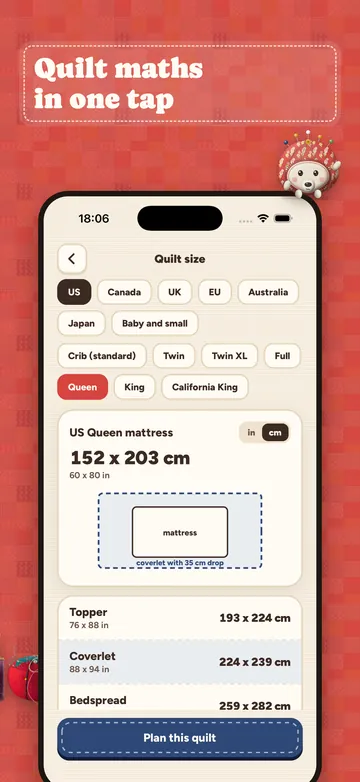
Here is the nice part. You never have to multiply by 1.414 again. SewNQuilt's HST and units calculator works out half square triangles 2, 4 and 8 at a time, plus quarter square triangles, flying geese and square in a square, in inches or centimetres. Tell it the finished size and how many units you need. It gives the cut size, the pairs and the fabric. The HST method comparator then puts the methods side by side for your exact quilt, so you choose speed or precision with your eyes open.
Want a block, not just a unit? The block library holds 164 quilt blocks, with history, grid, difficulty and cut lists where a standard construction exists, in both units. Drop them into the Quilt Planner, recolour them and get your yardage. Inchy runs the numbers, Hexie cheers you on, and every answer comes from a tested math engine.
SewNQuilt Pro comes with weekly, monthly or yearly plans ($49.99 a year in the US). Get SewNQuilt for iPhone, iPad and Android.
FAQ
What size square do I cut for a 3 inch half square triangle?
Cut 3 7/8 in squares for the 2 at a time method, 5 1/2 in squares for 4 at a time, or 7 3/4 in squares for 8 at a time. If you like to trim, cut 4 in squares and trim each unit to 3 1/2 in.
What is the 7/8 rule for half square triangles?
Add 7/8 in to the finished size to get the cut square for 2 at a time HSTs. The exact geometric allowance is 0.854 in, and 7/8 in is the nearest ruler line above it. In metric, with a 0.75 cm seam, add 2.6 cm.
How do I make 8 half square triangles at once?
Cut two squares at 2 x (finished + 7/8 in), draw both diagonals, sew 1/4 in on both sides of each, then cut in half both ways and on the diagonals. For 4 in finished HSTs that is 9 3/4 in squares; for 8 cm finished, 21.2 cm.
Why are my 4 at a time HSTs stretched?
Their outer edges are on the bias, the stretchiest direction of the weave. Starch the squares before cutting, press with an up and down motion, and cut 1/4 in larger so you can trim back to size.
Should I press HST seams open or to the side?
Press to the dark side for nesting and strength, or open for the flattest result and the easiest trimming. Open is the better choice for small HSTs and blocks where many points meet.
Can I use charm squares or layer cakes for HSTs?
Yes. A pair of 5 in charm squares sewn with the oversize and trim method (finished + 1 in) gives two HSTs that trim to 4 in finished (4 1/2 in unfinished). A pair of 10 in layer cake squares sewn 8 at a time gives eight HSTs that trim to 4 in finished.
How many squares do I need for 100 HSTs?
With 2 at a time you need 50 pairs (100 squares). With 4 at a time, 25 pairs. With 8 at a time, 13 pairs, which gives 104 HSTs and four spares.
Related guides
- Flying geese size chart: no waste and stitch and flipRead the guide
- Fat quarter size and precut sizesRead the guide
- How to make a quilt, start to finishRead the guide
- Seam allowance for sewing and quiltingRead the guide
- Quilt sizes for every bedRead the guide
- Free half square triangle calculatorOpen the tool
Sources
- National Institute of Standards and Technology (NIST), SI units: length (1 in = 2.54 cm exactly), https://www.nist.gov/pml/owm/si-units-length, checked 31 Oct 2026.
- Patchwork Posse, "8 half square triangles at once" tutorial and chart (3 in finished: 7 3/4 in; 4 in finished: 9 3/4 in), https://www.patchworkposse.com/8-half-square-triangles-at-once-tutorial/, checked 31 Oct 2026.
- Quilting Daily, "Quilt blocks: simple math, part 2" (allowances for squares and triangles), https://www.quiltingdaily.com/quilt-blocks-simple-math-part-2, checked 31 Oct 2026.
- Moda Fabrics, precut sizes (5 in charm squares, 10 in layer cakes), https://my.modafabrics.com/node/29570, checked 31 Oct 2026.
- Quilt Index, historic block documentation (Churn Dash, Bear's Paw, Ocean Waves), https://www.quiltindex.org/, checked 31 Oct 2026.
Image credits
- Ann Perkas on Pexels, ID 15337117, https://www.pexels.com/photo/tiled-wall-in-close-up-shot-15337117/
- Drawings: SewNQuilt drawing engine.
- Chart: SewNQuilt, built from the chart values on this page.
- Screenshot: SewNQuilt app (real screenshot).