

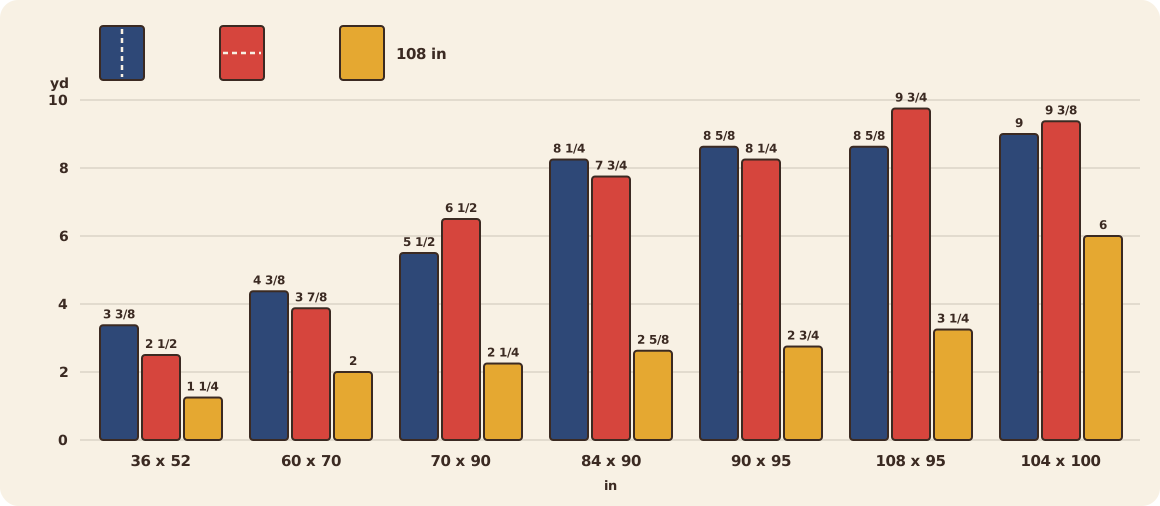
Quilt backing yardage chart (yards)
Sizes are the commonly printed US pattern sizes. Backing is the top plus 4 in on every side (longarm ready). Pieced backings use 42 to 44 in quilting cotton with 40 in usable after the selvages are removed and 1/4 in seams. Wide back is 108 in fabric with 104 in usable. Every amount is rounded up to the next 1/8 yd, the cut most North American shops sell.
| Quilt top | Backing size | Vertical seams | Horizontal seams | 108 in wide back | Domestic (3 in margin), best pieced |
|---|---|---|---|---|---|
| Crib 36 x 52 in | 44 x 60 in | 2 panels, 3 3/8 yd | 2 panels, 2 1/2 yd | 1 3/4 yd (1 1/4 yd turned) | 2 3/8 yd |
| Throw 60 x 70 in | 68 x 78 in | 2 panels, 4 3/8 yd | 2 panels, 3 7/8 yd | 2 1/4 yd (2 yd turned) | 3 3/4 yd |
| Twin 70 x 90 in | 78 x 98 in | 2 panels, 5 1/2 yd | 3 panels, 6 1/2 yd | 2 3/4 yd (2 1/4 yd turned) | 5 3/8 yd |
| Full 84 x 90 in | 92 x 98 in | 3 panels, 8 1/4 yd | 3 panels, 7 3/4 yd | 2 3/4 yd (2 5/8 yd turned) | 7 1/2 yd |
| Queen 90 x 95 in | 98 x 103 in | 3 panels, 8 5/8 yd | 3 panels, 8 1/4 yd | 2 7/8 yd (2 3/4 yd turned) | 8 yd |
| King 108 x 95 in | 116 x 103 in | 3 panels, 8 5/8 yd | 3 panels, 9 3/4 yd | 3 1/4 yd, turned | 8 1/2 yd |
| Cal king 104 x 100 in | 112 x 108 in | 3 panels, 9 yd | 3 panels, 9 3/8 yd | 6 yd (two lengths) | 8 7/8 yd |
Bold is the cheaper pieced layout. "Turned" means the wide back runs sideways, so its print runs across the quilt; that saves fabric whenever the print has no up and down. The king only fits one wide back length turned, and the cal king backing (112 x 108 in) is wider than 104 in both ways, so it takes two lengths seamed, or one length of 118 in (3 m) wide backing if your shop stocks it (check the usable width on the bolt).
Metric backing chart (metres)
Same quilts in centimetres, backing 10 cm larger on every side, 102 cm usable width, 0.75 cm seams, wide back 274 cm with 264 cm usable, rounded up to 10 cm.
| Quilt top | Backing size | Vertical seams | Horizontal seams | 274 cm wide back |
|---|---|---|---|---|
| 91 x 132 cm | 111 x 152 cm | 2 panels, 3.1 m | 2 panels, 2.3 m | 1.6 m (1.2 m turned) |
| 152 x 178 cm | 172 x 198 cm | 2 panels, 4.0 m | 2 panels, 3.5 m | 2.0 m (1.8 m turned) |
| 178 x 229 cm | 198 x 249 cm | 2 panels, 5.0 m | 3 panels, 6.0 m | 2.5 m (2.0 m turned) |
| 213 x 229 cm | 233 x 249 cm | 3 panels, 7.5 m | 3 panels, 7.0 m | 2.5 m (2.4 m turned) |
| 229 x 241 cm | 249 x 261 cm | 3 panels, 7.9 m | 3 panels, 7.5 m | 2.7 m (2.5 m turned) |
| 274 x 241 cm | 294 x 261 cm | 3 panels, 7.9 m | 3 panels, 8.9 m | 3.0 m, turned |
| 264 x 254 cm | 284 x 274 cm | 3 panels, 8.3 m | 3 panels, 8.6 m | 5.5 m (two lengths) |
How much bigger than the quilt top should the backing be?
Longarm: 4 in (10 cm) on every side, which is 8 in (20 cm) added to both the width and the length. The longarm frame clamps the backing to rollers at top and bottom and holds the sides with clamps. The extra fabric is what those grip, and it gives the quilter room to stitch right to the edge of your top. Many longarm services ask for 4 in or more and a squared backing, so read your quilter's checklist before you cut.
Domestic machine or hand quilting: 2 to 3 in (5 to 8 cm) on every side. Layers shift a little while you baste and quilt, and quilting draws the top in. That margin keeps the backing from ending up short at a corner. If this is your first quilt, take the full 3 in.
Batting is cut to the same size as the backing, so the same margin applies to both.
The backing panel formula
Here is the formula our calculators use (backing_yardage). It works for any quilt and any fabric width.
- Backing size = top width + 2 x margin, by top length + 2 x margin.
- Panels for vertical seams = ceil((backing width minus 1/2 in) / (usable width minus 1/2 in)). Each panel is as long as the backing length.
- Panels for horizontal seams = ceil((backing length minus 1/2 in) / (usable width minus 1/2 in)). Each panel is as long as the backing width.
- Fabric = panels x panel length for each layout. Buy the smaller one, rounded up to 1/8 yd (4 1/2 in) or 10 cm.
The 1/2 in is the two 1/4 in seam allowances each joined panel loses (in metric, use 1.5 cm for two 0.75 cm seams). "Ceil" means round up to a whole panel: you cannot buy 1.7 panels.
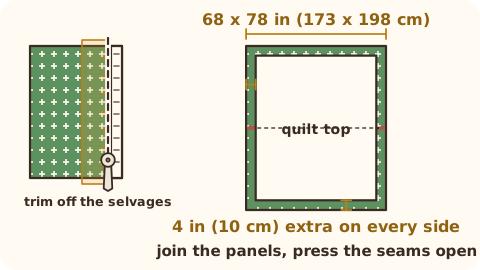
Why compare both ways? The panel count is often the same, but the panel length is not. A throw backing of 68 x 78 in needs two panels either way. Vertical panels are 78 in long; horizontal panels are 68 in long. Same seams, 20 in less fabric.
Worked example: throw, in inches
Top 60 x 70 in, quilted on a longarm.
- Backing = 68 x 78 in.
- Vertical: ceil((68 minus 1/2) / (40 minus 1/2)) = ceil(1.71) = 2 panels x 78 in = 156 in (4 1/3 yd). Buy 4 3/8 yd.
- Horizontal: ceil((78 minus 1/2) / 39 1/2) = ceil(1.96) = 2 panels x 68 in = 136 in (3 7/9 yd). Buy 3 7/8 yd.
- Choose horizontal and save 1/2 yd.
Quilting it yourself on a domestic machine with a 3 in margin? The backing becomes 66 x 76 in, and horizontal seams take 2 x 66 = 132 in: buy 3 3/4 yd.
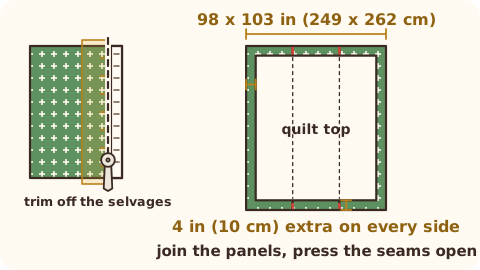
Worked example: queen, in inches
Top 90 x 95 in, longarm.
- Backing = 98 x 103 in.
- Vertical: ceil(97 1/2 / 39 1/2) = 3 panels x 103 in = 309 in. Buy 8 5/8 yd.
- Horizontal: ceil(102 1/2 / 39 1/2) = 3 panels x 98 in = 294 in. Buy 8 1/4 yd.
- Wide back (104 in usable): one length. Keep the print upright and you need 103 in, so buy 2 7/8 yd. If the print can run sideways, 98 in is enough: 2 3/4 yd.
That is 8 1/4 yd of quilting cotton against 2 7/8 yd of wide back, and only one length to square up instead of three panels to join. For queen and king quilts, wide backing is almost always the better buy.
Worked example: metric throw, in centimetres
Top 150 x 200 cm, longarm, quilting cotton with 102 cm usable.
- Backing = 170 x 220 cm.
- Vertical: ceil((170 minus 1.5) / (102 minus 1.5)) = ceil(1.68) = 2 panels x 220 cm = 440 cm.
- Horizontal: ceil((220 minus 1.5) / 100.5) = ceil(2.17) = 3 panels x 170 cm = 510 cm.
- Choose vertical and buy 4.4 m.
Notice this one flips: the metric throw is long and narrow, so two vertical panels cover the 170 cm width, while the 220 cm length would need three. That is exactly why you calculate both ways every time.
Vertical vs horizontal vs wide back: which should I choose?
Vertical seams run the length of the quilt. The fabric's lengthwise grain runs top to bottom, so a directional print stays upright. They win on twin, king and cal king sized backings.
Horizontal seams run across the quilt. They win on crib, throw, full and queen backings in our chart. The print turns sideways, which only matters for directional prints such as trees, text or animals walking one way.
Wide back (108 in, 274 cm). One length covers any backing up to 104 in (264 cm) in one direction. From a full size up, it is less than half the yardage of a pieced back and has no seams at all. Wide backs also come in 90 in goods (86 in, 218 cm usable), handy for twins.
Our take: for throws and anything smaller, piece the back from quilting cotton; it is a good home for an orphan block or a fat quarter strip down the middle. For full, queen and king, buy wide backing. It is less fabric, less cutting and a flatter back.
Do longarm quilters prefer horizontal seams?
Many do. With horizontal seams the seam runs parallel to the rollers, so the backing winds evenly and tension stays the same across the frame. Vertical seams roll up on themselves and build a slightly thicker band. Preferences vary from quilter to quilter, and plenty load vertical seams happily, so ask yours before you sew.
How to piece a quilt back, step by step
- Cut the panels to length. Square one end of the fabric first, then cut each panel to the panel length from your calculation.
- Remove the selvages. Trim about 1/2 to 1 in (1.3 to 2.5 cm) off both edges. Selvages are woven tighter than the rest of the fabric and shrink differently in the wash, which puckers a seam that includes them. Your usable width is what remains, usually 40 to 42 in (102 to 107 cm).
- Match any print. For a large print, line up the motifs before you pin. It can cost one pattern repeat in length, so buy that extra.
- Sew the panels together. Right sides together. A 1/4 in (0.75 cm) seam is fine; many longarm services ask for 1/2 in (1.5 cm) on backing seams for strength. In the inch chart above, a 1/2 in seam leaves every panel count unchanged.
- Press the seams open. Open seams lie flat, spread the bulk and roll evenly on a longarm frame.
- Square the backing. Fold it in half, then check the corners and edges are at right angles. Trim if needed, keeping the full margin on every side. Longarm quilters especially need straight top and bottom edges to load on the rollers.
- Mark the top edge with a safety pin if the print has a direction, so your quilter loads it the right way up.
Cut the batting to the backing size
Batting is cut to the same size as the backing: 68 x 78 in for the longarm throw above. Unfold it a day ahead or relax it as the package says. If one piece is too narrow, butt two straight cut edges together and join them with a wide zigzag or batting tape. Never overlap batting; the ridge shows through the quilt.
Mistakes and fixes
Using the full 44 in width in the maths. Bolts say 42 to 44 in, but after selvages and a straightening cut you have about 40 in. Fix: calculate with 40 in (102 cm) usable and you will never be short by a sliver.
Adding 4 in in total instead of on every side. A 60 x 70 in top with a 64 x 74 in backing leaves the longarm nothing to clamp. Fix: add the margin twice to each measurement, 8 in (20 cm) in total.
Leaving the selvages on. They pucker the seam after washing. Fix: trim them off before you sew.
Turning a directional print sideways. Horizontal seams and turned wide backs run the print across the quilt. Fix: for a one way print, use vertical seams or buy the wide back to the full backing length.
Forgetting shrinkage. Prewashed cotton can lose a few percent, and mills differ. Fix: if you prewash backing fabric, buy an extra 1/8 to 1/4 yd (10 to 20 cm) on a pieced back.
Buying exactly to the inch. A shop's cut can be a little crooked. Fix: rounding up to the next 1/8 yd or 10 cm, as in our tables, covers a straightening cut.
Let SewNQuilt do the backing maths
Finish the top, measure it once, and let Inchy do the rest. The backing calculator in SewNQuilt compares vertical seams, horizontal seams and wide backs side by side and shows where every seam falls on the back. Set the margin (4 in or 10 cm per side for a longarm quilter, less for quilting at home) and watch the yardage change.
Planning the whole finish? Quick quilt plan works out backing, binding and batting at once for one quilt. Save the result to your project and add it to your shopping list, so the yardage is in your pocket at the fabric shop. And the Bed quilts guide walks through wide backs and batting for big quilts, with Hexie cheering every seam.
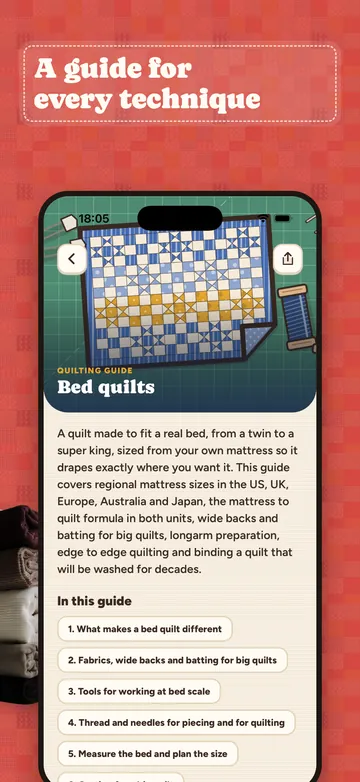
SewNQuilt is on iPhone, iPad and Android. Get the app.
FAQ
How much backing do I need for a queen size quilt?
For a 90 x 95 in queen top with a 4 in longarm margin, the backing is 98 x 103 in. Pieced from quilting cotton that is 8 1/4 yd with horizontal seams (8 5/8 yd vertical). With 108 in wide backing it is one length: 2 7/8 yd.
How much backing do I need for a throw quilt?
A 60 x 70 in throw needs a 68 x 78 in backing for longarm quilting: 3 7/8 yd of quilting cotton with one horizontal seam. With 108 in wide backing, 2 1/4 yd (or 2 yd turned sideways).
Is it cheaper to use 108 inch wide backing?
From a full size up, almost always. A queen takes 2 7/8 yd of wide back against 8 1/4 yd of quilting cotton, so even at a higher price per yard the wide back usually costs less and saves you the seams.
Should backing seams be vertical or horizontal?
Whichever needs less fabric for your size, unless your print has a direction or your longarm quilter asks for one. Calculate both: on a throw, horizontal saves 1/2 yd; on a twin, vertical saves a full yard.
Should I press backing seams open?
Yes. Open seams lie flat, spread the bulk and roll evenly on a longarm frame. Remove the selvages before you sew so the seam does not pucker.
How much bigger should batting be than the quilt top?
Cut batting to the backing size: 4 in (10 cm) larger on every side for longarm, 2 to 3 in (5 to 8 cm) for domestic quilting.
Can I make a quilt back from leftover blocks?
Yes, and it is a lovely way to use them. Build a strip of blocks or scraps into one panel, sew it between wider panels, and make sure the finished back still has the full margin on every side.
Related guides
- Quilt sizes chartfind the top size before you buy backing.Read the guide
- How much binding for a quiltfinish the edge with the right strips.Read the guide
- How to make a quiltthe whole process, layering and basting included.Read the guide
- Fat quarter sizepieced backs from precuts and stash.Read the guide
- Free toolQuilt backing calculatorOpen the tool
Sources
- Cotton Cuts, Preparing your quilt for longarm quilting (backing 4 in larger on all sides, selvages removed, seams pressed open, horizontal backing seams). https://www.cottoncuts.com/preparing-your-quilt-for-longarm-quilting (checked 31 Oct 2026).
- The Warm Company, batting care and shrinkage. https://www.warmcompany.com/ (checked 31 Oct 2026).
- Hobbs Batting, batting preparation and care. https://www.hobbsbatting.com/ (checked 31 Oct 2026).
- Moda Fabrics, precuts and fabric widths. https://my.modafabrics.com/node/29570 (checked 31 Oct 2026).
- NIST, SI units of length (1 yd = 0.9144 m exactly). https://www.nist.gov/pml/owm/si-units-length (checked 31 Oct 2026).
Image credits
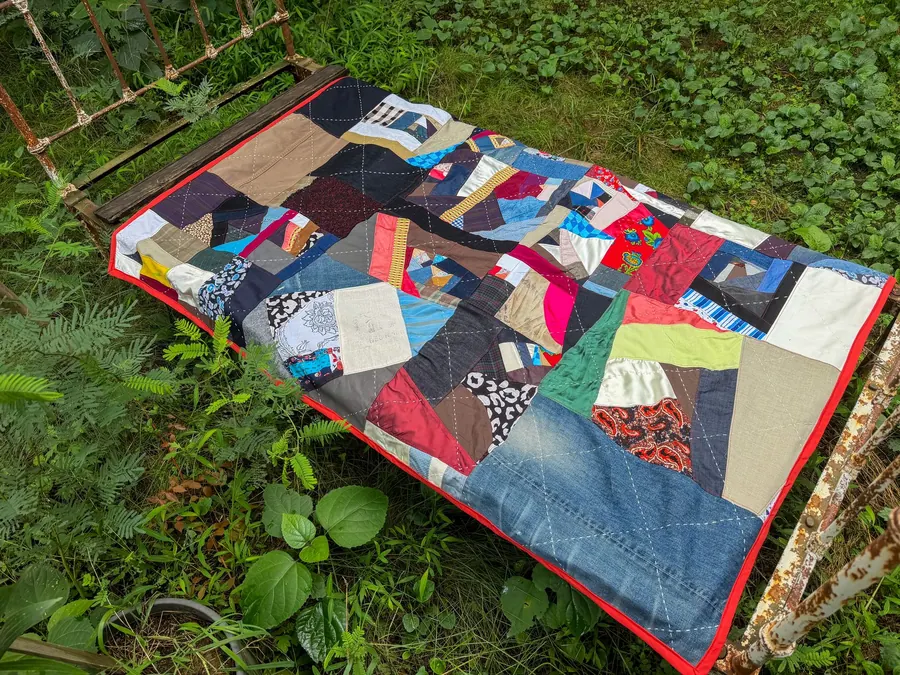
- Crazy patchwork quilt on an iron bed frame: Canan İldeniz on Pexels (ID 39647603).
- Drawings: SewNQuilt drawing engine.
- Chart: SewNQuilt, built from the yardage table on this page.
- Screenshot: SewNQuilt app.